All posts by Dr. Robin Starbuck

Welcome suffering entirely K.C.? RSpira
Abidance as self-enquiry -RSpira
Self-abidance is the deeper aspect of self-enquiry. Most people mistake themselves for a bundle of thoughts, feelings, memories, sensations, etc.
First step: what is it that is aware of my thoughts, feelings, sensations etc? WHO AM I? = What is it that cannot be remo fed from me? What has been continuous all my life? What is the continuous element in all these experiences? Self-inquiry starts with a question, an investigation. Nothing more for the mind to do coz it’s always directed toward objective experience. ASK THE QUESTION THEN WAIT FOR THE ANSWER: THE WAITING IS SELF- ABIDANCE (Atma vichara, sanskrit). Not accurate translation because normally we engage in a series of thoughts and perceptions about that thing. But we cannot think about or perceive ourself because there’s nothing objective there. The larger part of self-inquiry is just self-abidance
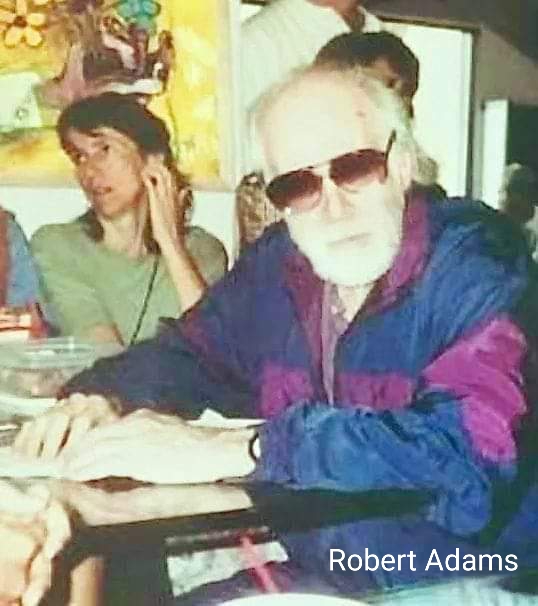
Just be very quiet -RAdams
The higher Self is your real nature.
That is what you really are.
So naturally when you become still long enough, when you stop shouting and making things happen and wanting things and doing things, when you have become totally still long enough and leave whatever happens, happen, then you become the real Self. That seems to rush at you because it is unfolding as you and when you are quiet, you become That. Simple.
All your job is to become quiet. Become still. Nothing to prove, nothing to do, nothing to fight. You leave the world alone. Everything will take care of itself. You don’t worry any longer. And the Self will rush into your arms and you will embrace and live happily ever after.
Transcript 198
Everything is in a
State of Flux
8th November, 1992
Robert Adams Satsangs
The Collected Works
All the silly lingo!!!
Don’t care what happens -JK
J. Krishnamurti, the great Indian philosopher and spiritual teacher, spoke and traveled almost continuously all over the world for more than fifty years attempting to convey through words – which are content – that which is beyond words, beyond content. At one of his talks in the later part of his life, he surprised his audience by saying, “Do you want to know my secret?” Everyone became very alert. Many people in the audience had been coming to listen to him for twenty or thirty years and still failed to grasp the essence of his teaching. Finally, after all these years, the master would give them the key to understanding. “This is my secret,” he said. “I don’t mind what happens.”
He did not elaborate, and so I suspect most of his audience were even more perplexed than before. The implications of this simple statement, however, are profound.
When I don’t mind what happens, what does that imply? It implies that internally I am in alignment with what happens. “What happens,” of course, refers to the suchness of this moment, which always already is as it is. It refers to content, the form that this moment – the only moment there ever is – takes. To be in alignment with what is means to be in a relationship of inner nonresistance with what happens. It means not to label it mentally as good or bad, but to let it be. Does this mean you can no longer take action to bring about change in your life? On the contrary. When the basis for your actions is inner alignment with the present moment, your actions become empowered by the intelligence of Life itself.
Eckhart Tolle, ‘A New Earth’
Definitions -RM
🌸 🌟 🌸 🌸 🌟 🌸 🌸 🌟 🌸 🌸 🌟 🌸
- * * Kundalini Sakti – Chinmaya Deha * * *
Yesterday morning an Andhra youth came here with his wife.
It seems he has come here after visiting the whole of the Himalayan region.
In the afternoon at 3 o’clock he
approached Bhagavan and said,
“Swami, is the manifestation of Kundalini Sakti
(a form of yogic power) possible only for those
who follow the yogic path of acquiring sakti (power) or
is it possible also for those
who follow the path of devotion (bhakti) or love (prem)?”
Bhagavan Sri Ramana :
“Who does not have Kundalini Sakti?
When the real nature of that Sakti is known,
it is called Akhandakara Vritti (Plenary consciousness) or
Aham Sphurana (effulgence of ‘I’, ‘I’).
Kundalini Sakti is there for all people
whatever path they follow.
It is only a difference in name.”
Questioner: “It is said that that sakti manifests itself in
five phases, ten phases, hundred phases and a thousand
phases. Which is true – five or ten or a hundred or a
thousand?”
Bhagavan Sri Ramana :
“Sakti has only one phase.
If it is said to manifest itself in several phases,
it is only a way of speaking.
The Sakti is only one.”
Questioner: “To realise the Self, some say you must
concentrate your mind on the anahatam (the 4th of the mystical
chakras [plexuses] of the body); some say on the sahasraram (a
mystical plexus in the brain with a thousand petals); and some
say on the muladharam (a mystical plexus about the organs of
generation). Which is the most important?”
Bhagavan Sri Ramana :
“All are important.
Self (Atman) is everywhere in the body.
Some say you should see it in the muladharam;
some say in the anahatam and
some say in the sahasraram.
It is the same whichever it is.
But, for all of them, the place of birth
and of dissolution is anahatam only.”
Questioner: “Can a Jnani help not only those who follow
his path but also others who follow other paths?”
Bhagavan Sri Ramana :
“Undoubtedly.
He can help people whatever
path they choose to follow.
It is something like this.
Suppose there is a hill.
There will be very many paths to climb it.
If he were to ask people to climb by the way he came,
some may like it and some may not.
If people who do not like it are asked to climb by that path,
and by that path only,
they will not be able to come up.
Hence a Jnani helps people following
any particular path whatever it may be.
People who are midway may not know
about the merits and demerits of other paths,
but one who has climbed the summit and sits
there observing others coming up is able to see all the paths.
He will therefore be able to tell people
who are coming up to move a little to this side or
that or to avoid a pitfall.
The goal is the same for all, you see.”
The young man was not satisfied with the replies given
by Bhagavan and again began asking questions about Kundalini Sakti and how it arises.
Bhagavan appeared unconcerned about those questions
but when they were asked repeatedly, said,
“What do I know about those paths?
Please ask those who know them well.”
Giving up the topic,the young man took up the topic of spiritual bodies (chinmaya dehas) by saying,
“My Guru gave a darshan in chinmaya rupam
(form) on such and such a day, spoke to me of this and that,”
and started speaking about the miracles performed by his
deceased Guru.
Bhagavan did not speak but kept quiet for some time.
At last the young man said,
“Is it a fact that Lord Krishna is still with his chinmaya deha (spiritual body)?”
Bhagavan Sri Ramana replied with patience:
“Does chinmaya deha mean the human body?
Chinmaya means Chit-prakasa, i.e. luster of the spirit.
That light is always existent:
“ Arjuna, I am the Self seated in the heart of all beings.
I am the beginning and middle and
also the end of all beings.
Gita, X: 20
“Does that mean that
He is in the hearts of all beings with this material body?
It means He is in the hearts of all beings in the shape Aham Sphurana (effulgence of ‘I’, ‘I’).
That effulgence of the Self is known as Chit-prakasa or Chinmaya.”
Questioner: “Is the same thing said of other Mahapurushas
(great personages) or is it that Lord Krishna’s body becomes
Chinmayam and remains like that?”
Bhagavan Sri Ramana :
“Oh ! You think that that body becomes
Chinmayam and sits somewhere.
The whole world is Chinmayam.
That being so is it that one body alone has become Chinmayam?
Visions (sakshatkaras) are also like this.
People say that they descend from somewhere with a body.
That which is omnipresent you leave or ignore and
talk of karam and sakshatkaram.”
~ Letters from Sri Ramanasramam, 18th January, 1949
Thanks Sri Ramana Maharshi Teachings. श्री रमण महर्षि के उपदेश
🌸 🌟 🌸 🌸 🌟 🌸 🌸 🌟 🌸 🌸 🌟 🌸 🙏
The I-thought -RM, RSpira
“WHO AM I ?”: THE FULL PROCESS OF ‘SELF-ENQUIRY’
“For all thoughts, the source is the ‘I-Thought’.
The mind will merge only by the Self-enquiry; ‘Who Am I?’
The thought; ‘Who am l?’, will destroy all other thoughts, and finally kill itself, also.
If other thoughts arise – without trying to complete them, one must enquire: ‘to whom did this thought arise?’
What does it matter how many thoughts arise? As each thought arises, one must be watchful and ask: ‘To whom is this thought occurring’?
The answer will be: ‘to me’.
If you then enquire: ‘Who am I ?’, the mind will return to its Source (or where it issued from). The thought which arose, will also submerge.
As you practise like this – more and more, the power of the mind to remain at its source, is increased.
By means of a moderate quantity of satvic (pure) food, which is superior to all other rules and regulations of self discipline, the satvic – or pure quality of the mind, will grow, and Self-Enquiry – will be helped.
Though ancient and timeless sense, attachments – in the shape of Vasanas (subtle tendencies) may rise; countless like the waves of the sea, they will all be destroyed, as ‘dhyana’ progresses.
Without giving any room. for doubt; ‘whether it would at all be possible to eradicate all those vasanas, and BE The Self – Alone, one must take hold – ceaselessly, of dhyana of The Self.
However great a sinner one may be, instead of lamenting: ‘I am a great sinner, how can I make any progress?’ – one must completely forget the fact of being a sinner, and earnestly pursue meditation of Self. He is then sure to succeed!
If the ego is present, all else will also exist. If it is absent, all else will also vanish.
As ego is all ‘this’; to enquire what this ego is. is to give up all attachment.
Controlling speech and breath, and diving deep within oneself; as a man dives into water to recover something that has fallen there, one must find out The Source from whence the ego rises, by means of ‘keen insight’.
‘Enquiry’ – which constitutes the path of Jnana, consists not in orally repeating ‘I’ – ‘I’, but in searching – by means of a deeply introverted mind – wherefrom the ‘i’ springs.
To think: ‘i’ am not this’, or ‘ii am that’, may be of help in the enquiry, but cannot be ‘the actual Enquiry’.
When we quest within our mind, ‘Who am i ?’, and reach The Heart, the ‘i’ topples down – and immediately, another entity will reveal itself, proclaiming ‘I-I’.
Even though IT also merges saying, ‘I’, IT does not connote the ego, but ‘The One Perfect Existence’.
If we unceasingly investigate the form of the mind, we find there is no such thing as the mind.
This is The Direct Path – open to all.
Thoughts alone constitute the mind; and for all thoughts, ‘the base’ – or Source, is the ‘I-thought’: This ‘i’, is the mind.
If we go inward – questing for The Source of the ‘i’, the ‘i’ topples down. This is ‘The Jnana Enquiry’.
Where the ‘i’ merges, another entity emerges, as ‘I-I’.., of its own accord.
… That is The Perfect Self!
There is no use removing doubts. If we clear one doubt another arises, and there will be no end of doubts.
All doubts will cease only when ‘the doubter’, and his source, have been found. Seek for the source of the doubter, and you find he is really nonexistent;
Doubter ceasing, doubts will cease.
Reality – being yourSelf, there is nothing for you to Realize. All are regarding ‘the unreal’ – as Real. What is required is that you give up regarding ‘the unreal’, as Real.
The object of all meditation (Dhyana), or Japa, is only that: to give up all thoughts – regarding the non-self; to give up many thoughts, and to hold on to one thought.
The object of all sadhana is to make the mind one-pointed, and to concentrate it on one thought, and thus exclude our many thoughts.
If we do this, eventually – even the one thought will go, and the mind will get extinguished, in its Source.
When we Enquire within: ‘Who am I ?’, the ‘i’ investigated is the ego. It is that which makes Vichara (Enquiry) also.
The Self has no ‘vichara’.
That which makes the enquiry, is ‘the ego’. The ‘i’ about which The Enquiry is made, is also the ego.
As the result of The Enquiry, the ego ceases to exist, and only The Self is found to exist.
What is the best way of killing the ego?
… To each person, that way is best, which appears easiest, or appeals the most.
All the ways, are equally good, as they lead to the same goal, which is the merging of the ego, in The Self.
What The Bhakta calls Surrender, the man who does Vichara calls Jnana. Both are trying to take the ego back to The Source from which it sprang, and make it merge there.
To ask the mind to kill itself, is like making the thief the policeman. He will go with you and pretend to catch the thief, but nothing will be gained.
So you must turn inward, and see from whence the mind rises, and then it will cease to exist.
- Breath – and mind, arise from the same Source, and when one of them is controlled – the other is also controlled.*
As a matter of fact, in the quest method – which is more correctly: ‘Whence Am I?’ and Not merely ‘Who am I?’:
We are not simply trying to eliminate, saying; ‘We are not the body, nor the senses and so on’, to reach what remains as; ‘The Ultimate Reality’, but we are trying to find out: ‘whence’ the ‘I-thought’ – or the ego, arises within us.
The method contains within it – though implicitly, and not expressly: ‘the watching of the breath’.
When we watch wherefrom the ‘I-thought’ arises, we are necessarily watching The Source of breath also; as The ‘I-Thought’ and the breath, arise from ‘The Same Source’.
Breath Control – may do as an aid, but can never – by itself, lead to The Goal.
While doing it mechanically, take care to be alert in mind, and to remember the ‘I- thought’, and the quest for its Source.
Then you will find that where the breath sinks – there, the ‘I-Thought’ arises. They sink and arise together.
The ‘I-Thought’ will also sink along with the breath.
Simultaneously, another luminous and Infinite ‘I-I’ , will emerge, and it will be continuous and Unbroken. That is The Goal!
It goes by different names – God, Self, Kundalini, Shakti, Consciousness, etc.
‘Who am I?’ is not ‘a mantra’.
It means that you must find out where – in you, the ‘I-Thought’ arises, which is The Source of all other thoughts.
But if you find that Vichara Marga (The Path Of Enquiry) is too hard for you,
… Then you go on repeating ‘I-I’, and that will lead you to the same Goal.
There is no harm in using ‘I’ – as a ‘mantra’. It is the first name of God.
I ask you to see where the ‘I’ arises in your body; but it is not really quite correct to say that the ‘I’ rises from, and merges in, The Heart – on the right side of the chest.
The Heart is another name for The Reality, and IT is neither inside nor outside the body. There can be no ‘in’, and ‘out’ for IT; since IT – Alone, IS.
I do not mean by ‘Heart’ any physiological organ, any plexus of nerves or anything like that, but so long as one identifies oneself with the body and thinks he is the body, he is advised to see – in the body, where the ‘I-Thought’ rises, and merges again.
It must be The Heart, at the right side of the chest, since every man of whatever race and religion, and in whatever language he may be saying – ‘I’, points to the right side of his chest, to indicate himself.
This is True, all over the world!
So ‘That’ must be ‘The place’; and by keenly watching the emergence of the ‘I-Thought’ – on waking, and its subsiding – in sleep, one can see that it is in The Heart, on the right side.
First know who you are! This requires no ‘sastras’ (scripture) or scholarship. This is simple experience.
‘The State Of Being’ is ‘Now and Here’, all along. You have lost hold of yourself and are asking others for guidance.
The purpose of philosophy is to turn the mind inward. If you know yourself, no evil can come to you. Because you asked me – I have told you this.
The ego comes up only holding You (The Self). Hold your Self – and the ego will vanish.
Until then, the sage will be happy saying: ‘There is’, and the ignorant will be asking, ‘Where?’
Regulation of life; such as getting up at a fixed hour, bathing, doing mantra-japa, etc.; all this is for people who do not feel drawn to Self-Enquiry, or are not capable of it.
But for those who can practise this method; all rules and disciplines are unnecessary.
Undoubtedly, it is said in some books, that one should go on cultivating one good quality after another, and thus prepare for Moksha; but for those who follow The Jnana – or Vichara Marga, their sadhana is itself quite enough for acquiring all Daivic (Divine) Qualities;
They need not do anything else!
What is Gayatri? It really means; ‘Let me concentrate on ‘That’, which illumines All’.”
~ Ramana Maharshi ~
RSpira videos, rjs notes
How do you teach cultural things re form and understanding it’s a manifestation of being aware?
A child doesn’t know it’s an infant born into a world as one homogeneous mass and cannot distinguish between its body and its mother’s body. Like a fish in the ocean. After awhile the child begins to separate itself out – the I-thought arises and associates with its body as me entity, beginning of ego. Pre-egoic state (where the ego separates itself from experience) = beginning of NETI-NETI process. = “I’M NOT THIS, I’M NOT THAT.” I am consciousness. A child does this: I’m not this and I’m not that. I thought I was my mother’s body but I’m not. I am this body. Ego begins. Then the consciousness REMAINS STUCK AT THAT LEVEL the rest of the person’s life. That process continues until finally the person says I’m not my thoughts either. I’m not my thoughts. They come and go like my mother comes and goes, my sensations come and go like father.
What cannot be removed? What is with me always? Only BEING AWARE. A further step is the recognition of the ever-present unlimited nature of awareness. Post-egoic realization. If one separates from all things and says I am pure awareness = ENLIGHTENMENT = I-awareness with the body-mind-world. With yoga meditations, coming together with body-mind-world being merged in experience. To the infant and the animal consciousness has completely lost itself to the sea of undifferentiated experience. That’s the pre-egoic state that infants and animals are in. The ego develops by associating itself with the body-mind. Then it further develops itself but when it goes back to look at the things of the body-mind-world it finds they’re made of consciousness. Experience is merged with consciousness in the post-egoic state and consciousness is merged with experience in the pre-egoic state. THIS EXPLAINS THE MISUNDERSTANDING IN THE NEO-ADVAITA TEACHINGS.
THEY MISUNDERSTAND THE PRE-EGOIC STATE FOR THE POST EGOIC STATE. THEY DON’T DISTINGUISH BETWEEN THE TWO. THEY’RE DESCRIBING A PRE-EGOIC STATE WHERE CONSCIOUSNESS IS MERGED IN EXPERIENCE. IT’S QUITE DIFFERENT. EXPERIENCE IS MERGED IN CONSCIOUSNESS.
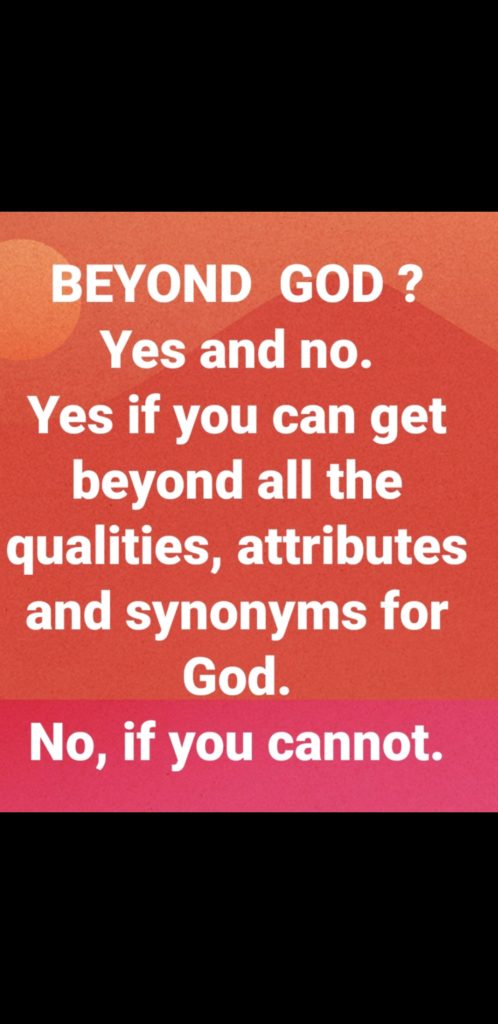
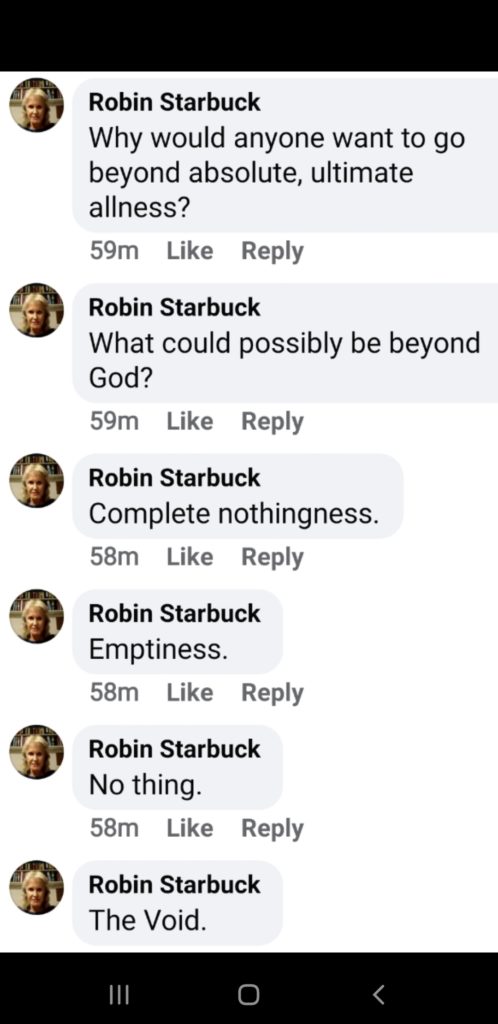
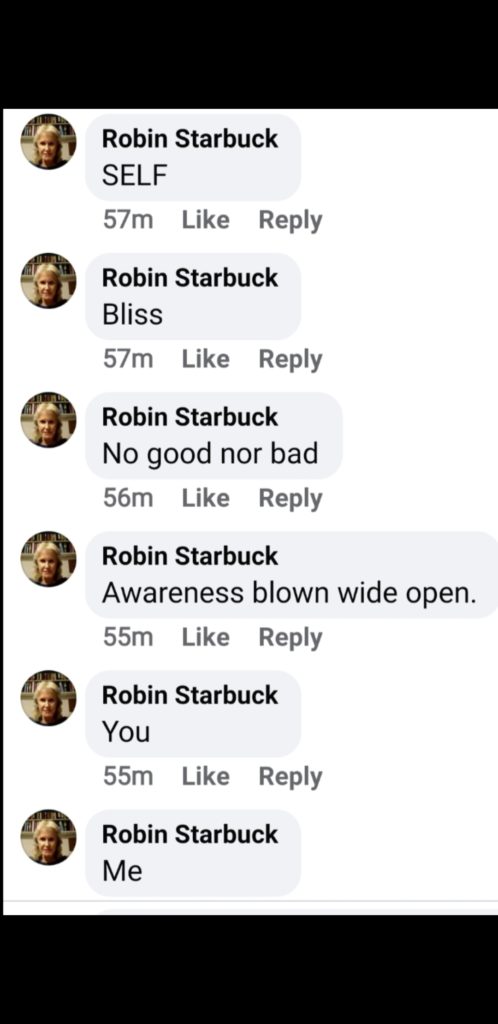
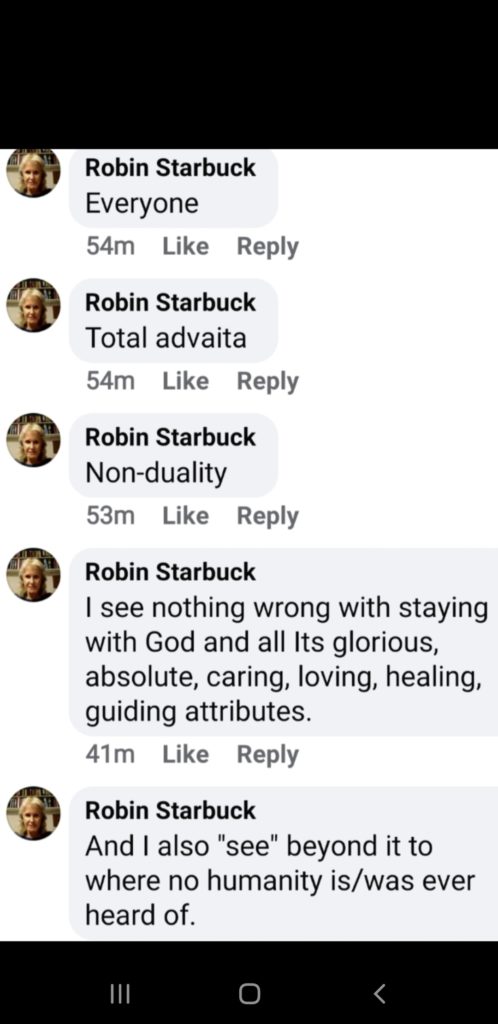
Is Beyond God possible? rjs