All posts by Dr. Robin Starbuck

About Dr. Robin Starbuck

Professor of English 1973 M.A., New York University 1989 Ph.D., New York University Linguistics

Search for method is another form of escape -JK

Though intellectually we may perceive the cause of suffering, it has but little influence on our lives. Though we may intellectually agree that so long as there is attachment there is fear and sorrow, yet our desire is so strongly possessive that it overcomes all reasoning. Even though we may know the cause of suffering, suffering will continue, for mere intellectual knowledge is not sufficient to destroy the cause. So when the mind through analysis discovers the cause of suffering, that very discovery itself may become a refuge. The hope that by discovering the cause of sorrow, suffering will cease, is an illusion.

Why does the mind seek the cause of sorrow? Obviously to overcome it. Yet in the moments of ecstasy there is no search for its cause; if there were, ecstasy would cease. In craving for ecstasy, we grope after those causes that stand in the way. This very craving for ecstasy and the intense desire to overcome sorrow prevent their fulfillment.

A mind that is burdened with the desire for reality, for happiness, for love, cannot free itself from fear. Fear deadens sorrow as also it distorts joy. Is our whole being in direct contact with sorrow as it is with happiness, with joy?

We are aware that we are not integral with sorrow; that there is a part of us which is trying to run away from it. In this process the mind has accumulated many treasures to which it clings desperately. When we realize this process of accumulation, then there is an urge to put a stop to it. Then we begin to seek methods, the way to get rid of these burdens. The very search for a method is another form of escape.

The choice of methods, of a way to rid yourself of those accumulated burdens, which cause resistance—this very choice is born of a desire not to suffer and is therefore prejudicial. This prejudice is the outcome of the desire for refuge, comfort.

The Collected Works of
J. Krishnamurti
Volume III 1936-1944
The Mirror of Relationship
Jiddu Krishnamurti
Searching for outcome is escape -JK

Though intellectually we may perceive the cause of suffering, it has but little influence on our lives. Though we may intellectually agree that so long as there is attachment there is fear and sorrow, yet our desire is so strongly possessive that it overcomes all reasoning. Even though we may know the cause of suffering, suffering will continue, for mere intellectual knowledge is not sufficient to destroy the cause. So when the mind through analysis discovers the cause of suffering, that very discovery itself may become a refuge. The hope that by discovering the cause of sorrow, suffering will cease, is an illusion.

Why does the mind seek the cause of sorrow? Obviously to overcome it. Yet in the moments of ecstasy there is no search for its cause; if there were, ecstasy would cease. In craving for ecstasy, we grope after those causes that stand in the way. This very craving for ecstasy and the intense desire to overcome sorrow prevent their fulfillment.

A mind that is burdened with the desire for reality, for happiness, for love, cannot free itself from fear. Fear deadens sorrow as also it distorts joy. Is our whole being in direct contact with sorrow as it is with happiness, with joy?

We are aware that we are not integral with sorrow; that there is a part of us which is trying to run away from it. In this process the mind has accumulated many treasures to which it clings desperately. When we realize this process of accumulation, then there is an urge to put a stop to it. Then we begin to seek methods, the way to get rid of these burdens. The very search for a method is another form of escape.

The choice of methods, of a way to rid yourself of those accumulated burdens, which cause resistance—this very choice is born of a desire not to suffer and is therefore prejudicial. This prejudice is the outcome of the desire for refuge, comfort.

The Collected Works of J. Krishnamurti – Volume III 1936-1944: The Mirror of Relationship
Jiddu Krishnamurti
On negativity and other nonsense RAdams

So when you react negatively to a situation, you can call it blasphemy. For you’re saying that God doesn’t know what he’s doing. That somehow consciousness has made a mistake someplace and you have to correct it, what nonsense. Yet most of us are doing these things everyday. Thinking that it’s up to us to straighten something out, up to us to correct somebody, it’s up to us to fix things. These things that you’re trying to correct and fix have been going on since the beginning of time, when the illusory universe first appeared. It’s all God’s leela. The sport of God, it’s a joke and you’re taking it seriously.

Is there any wonder that you’re feelings are always hurt. That you become angry everyday over some situation that is a trifle or nonsense, for you refuse to understand your divinity. You’re looking at yourself as a mortal being who has to go out into this world and fight for survival. It’s a lie, it’s not the truth.

This is what you should focus on day and night, and the best way to work on yourself is through self-inquiry. It encompasses all these things we’re talking about. But it’s up to you to do it and keep doing it day and night without stopping. Whatever comes to you, whatever you see everyday, whether it’s a trifle or it’s a serious thing, you have to inquire, “To whom does this come? Who feels this? Who sees this?” I know it’s hard for some of you to do this and this is because you’re not practicing the little things.

If you keep practicing the little things first, then when a so-called big catastrophe comes along, you’ll be able to handle it beautifully. You’ll simply say, “To whom does this come? To me, the ego, the I. I am free of it completely,” and be able to shrug it off and walk away in complete peace. But if you’re not practicing this, then when a so-called catastrophe comes along in your life, you will become violently upset over it, depressed, mad. It’s like when you’re going to die and leave your body. What you occupy your mind with when you die is that’s where you’re going to go. So some of you say, “Well I’m going to occupy my mind with Brahman, when I die I want to go straight to Brahman.” Of course it doesn’t work this way. Because if you have not been practicing previously to death, so-called, you will not be able to do it. When mr death comes to pay you a call, you will be in total fear. You will not be able to think straight. This is why it’s so important to practice now. It makes you stronger, in control.

Practice “Who am I?” constantly, continuously. “Who is this I that has this problem, this fear, this frustration? Where did the I come from?” As you keep separating yourself from the I daily, continuously soon you will not have to voice these things. It will be automatic. Whatever situation unveils itself, you will not say anything you will just look at it and smile and not be involved in it whatsoever. You will have risen to a higher consciousness, just by smiling at the condition, the situation. But if you are not practicing, then when a situation confronts you’ll get angry, mad, upset, depressed and the rest.


Transcript 226

Whatever You See Is The Self

25th February, 1993

Robert Adams Satsangs

The Collected Works

You are asleep -Gurdjieff

“In order to awaken, first of all one must realize that one is in a state of sleep. And in order to realize that one is indeed in a state of sleep, one must recognize and fully understand the nature of the forces which operate to keep one in the state of sleep, or hypnosis. It is absurd to think that this can be done by seeking information from the very source which induces the hypnosis.
….One thing alone is certain, that man’s slavery grows and increases. Man is becoming a willing slave. He no longer needs chains. He begins to grow fond of his slavery, to be proud of it. And this is the most terrible thing that can happen to a man.”

~ G.I.Gurdjieff

Being by Yourself, Satsang RAdams

Stop looking for scraps of fulfilment outside (your) Self.

(How to change milk into butter;)
We see no hope. We think it’s the end. Nobody loves us. We have incurable diseases. We have no job. The world looks like it!s coming to an end. There are wars. Mans inhumanity to man, and we don!t know where it!s going to end. But for whom it this ~ for YOU? Find out for whom is al the destruction. For whom is the negative conditions ~ NOT FOR YOU. Because You are not your body. AS long as You believe that You are your body, then the world becomes very real to You. As long You believe You are your mind, then the thoughts will frighten You, scare You, and make you do strange things. It will make you hate people, be suspicious, be doubtful and have all kind of problems; But when You inquire; “For whom is the mind, for whom is the body?” EVERYTHING STOPS. You see ~ the substratum of All existence is BLISS.That’s the bottom line, simply speaking.THE SUBSTRATUM OF ALL EXISTENCE IS BLISS.You come from Bliss, and You go to Bliss. It’s Your Real Nature.It’s like watching a movie. And in the movie there are good people, bad people, all kinds of people… Yet ~ You watch, you do not get involved in the movie. Even tho You know you’re watching a movie You know it’ll have an end. And You’ll awaken, get up and go home. It’s like that. Life is a cosmic movie.. Things begin, things has a middle and things has an end. Everything changes, and changes and changes continuously. NOTHING is ever the same. And it pulls You in. It pulls You into what we call maya, the grand illusion. It makes you believe that life is virtuous, and interesting. It gets You enmeshed in the things of this world. Until You become totally involved, and when you become totally involved, You see it turns out what you didn’t expect. It’s different than you thought.
Then you go after something else, and you go after something else and it never ends. Until you become so discouraged ~ You don’t know what to do with yourself.
This is true with every human being, EVERYBODY. So what to do?
Take time out by yourself. Think about these things.
That’s the first vessel; BE ALONE. BE HAPPY TO BE BY YOURSELF,that you can think about these things, and take control of Your mind and Your body. Spend lots of time by yourself. Being by Yourself is not loneliness, when You know what you are doing. Begin to love to be by your Self. You can’t wait for the time to be alone.
Number two, the second vessel; is the LOVE TO BE IN SATSANG. Satsang literally means to sit at the feet of the master. With an empty mind. Not with preconceived ideas, not with doubts, not with the fighting spirit., but with an open Heart. LOVE FOR SATSANG LEADS TO ENLIGHTENMENT. But you have to be careful, to whom you go, where you go. There are so many movements, so many organisations, so many so called spiritual groups, that’s hard to decide where to go. The best way to know is to ask your Self. Be by yourSelf. If you are sincere, if you have been working on yourself diligently, something in You will lead you a right place. Where you can grow and unfold beautifully.
Vehicle number three; YOU HAVE TO HAVE A DESIRE, TO ASSOCIATE WITH PEOPLE ON THE PATH LIKE YOURSELF, your friends, to associate WITH SAGES, with people think like you, who are trying to unfold. It’s easy for the world to pull You down and associate with the wrong people. and they look very interesting to you. But they pull you down into maya. And than you have to start all over again to work your way up. You gotta be careful, AWARE where you go, with whom you hang around. LET YOUR HEART TELL YOU.
❤ Robert Adams ~ How to change milk into butter. SATSANG ~ audiorecording
http://www.robert-adams.info/1990-09-02.mp3

spontaneous union with one’s self = enlightenment

THE ESSENCE OF RIBHU GITA: Verse 30
~Prof. N. R. Krishnamoorthi Aiyer.
The following verses constitute the teachings of Siva to Ribhu, who in turn transmits those teachings to his disciple Nidhaga Rishi.
The treatise goes by the name Ribhu Gita.
. . . . . . . . . . . . . . .

Sahaja Samadhi

  1. Remaining alertly aware and thought-free, with a still mind devoid of differentiation of Self and non-Self even while being engaged in the activities of worldly life, is called the state of Sahaja Nirvikalpa Samadhi (the natural state of abidance in the Self when all differentiation has ceased). This is called Akhandakara vritti, the ‘I’ of infinite perfection as contrasted with the ‘I am the body’ notion of those who have not realised the Self. (Ch.18, v.40)

*Sahaja (Sanskrit: सहज sahaja) means spontaneous enlightenment, or “spontaneous union with one’s self.”
. . . . . . . . . . . . . . .

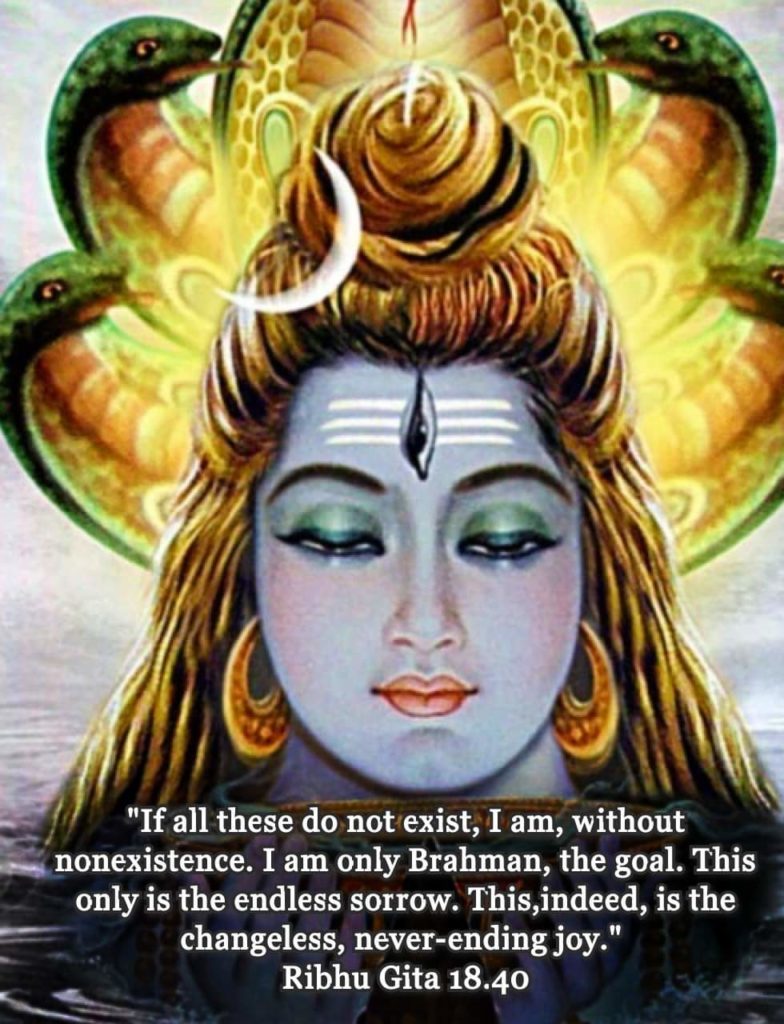
18.40. If all these do not exist, I am, without nonexistence. I am only Brahman, the goal. This only is the endless sorrow. This, indeed, is the changeless, never-ending joy.
(Translated by Ramamoorthy and Nome)

Everything is on your side -RAdams

Do not try to figure people out or analyze conditions, situations. You cannot do this, it’s too complicated. This is why it is written in all the great books, leave everything alone. Leave people alone, leave the world alone. Remember there is nothing to fear and there is nothing to fight. You are carried along in a stream of blessedness to your highest good. Everything is on your side. There is nothing against you you know. There is no one or nothing trying to hurt you. You do not have to defend yourself against anyone or anything, because there is nothing trying to hurt you.

Every situation that comes into your life is necessary at this time, everything. If you look at everybody and everything as God you’ll be on your right track. Look at every situation, every condition as Brahman.

If there is only Brahman, and there is only Brahman, how can there be mistakes someplace. How can people make a mistake? See what I’m saying? There is only the one, and that one is all-pervading, omnipresent, perfection, love, happiness, joy, that one is you.

You are the one.


Transcript 226

Whatever You See Is The Self

25th February, 1993

Robert Adams Satsangs: The Collected Works

Drawing by Jane Adams

Robert Adams

Be neither master nor slave -NM

Nisargadatta Maharaj On “Free Will”

Q: Surely, I am not the master of what happens. Its slave rather.

M: Be neither master, nor slave. Stand aloof.

Q: Does it imply avoidance of action?

M: You cannot avoid action. It happens, like everything else.

Q: My actions, surely, I can control.

M: Try. You will soon see that you do what you must.

Q: I can act according to my will.

M: You know your will only after you have acted.

Q: I remember my desires, the choices made, the decisions taken and act accordingly.

M: Then your memory decides, not you.

Q: Where do I come in?

M: You make it possible by giving it attention.

Q: Is there no such thing as free will? Am I not free to desire?

M: Oh no. You are compelled to desire. In Hinduism the very idea of free will is non-existent, so there is no word for it. Will is commitment, fixation, bondage.

Q: I am free to choose my limitations.

M: You must be free first. To be free in the world you must be free of the world. Otherwise your past decides for you and your future. Between what had happened and what must happen you are caught. Call it destiny or karma, but never—freedom. First return to your true being and then act from the heart of love.

Q: Within the manifested what is the stamp of the unmanifested?

M: There is none. The moment you begin to look for the stamp of the unmanifested, the manifested dissolves. If you try to understand the unmanifested wtih the mind, you at once go beyond the mind, like when you stir the fire with a wooden stick, you burn the stick. Use the mind to investigate the manifested. Be like the chick that pecks at the shell. Speculating about life outside the shell would have been of little use to it, but pecking at the shell breaks the shell from within and liberates the chick. Similarly, break the mind from within by investigation and exposure of its contradictions and absurdities.

Q: The longing to break the shell, where does it come from?

M: From the unmanifested.

Nisargadatta Maharaj

Not alive because you’re life itself

You cannot be alive for you are life itself.
It is the person you imagine yourself to be that suffers, not you. Dissolve it in awareness. It is merely a bundle of memories and habits.
From the awareness of the unreal to the awareness of your real nature, there is a chasm which you will easily cross, once you have mastered the art of pure awareness.

~Sri Nisargadatta Maharaj

No need for a teacher -JK

Question: If a man is in ignorance or at a loss to know what to do, is there no need of a guru to guide him?

KRISHNAMURTI: Can anyone help you to cross this aching void of daily life? Can any person, however great, help you out of this confusion? No one can. This confusion is self-created; this turmoil is the result of one will in conflict with another will. Will is ignorance.

I know the pursuit of gurus, teachers, guides, Masters is the indoor sport of many, the sport of the thoughtless all over the world. People say, “How can we prevent this chaotic misery and cruelty unless those who are free, the enlightened, come to our aid and save us from our sorrow?” Or they create a mental image of a favored saint and hang all their troubles round his neck. Or they believe that some super physical guide watches over them and tells them what to do, how to act. The search for a guru, a Master, indicates an avoidance of life.

Conformity is death. It is but the formation of habit, the strengthening of the unconscious. How often we see some ugly, cruel scene and recoil from it. We see poverty, cruelty, degradation of every kind; at first we are appalled by it, but we soon become unconscious of it.

We become used to our environment, we shrug our shoulders and say, “What can we do? It is life.” Thus we destroy our sensitive reactions to ugliness, to exploitation, cruelty, and suffering, also our appreciation and deep enjoyment of beauty. Thus there comes a slow withering of perception.

Habit gradually overcomes thinking. Observe the activity of your own thought and you will see how it is forming itself into one habit after another. The conscious is thus becoming the unconscious and habit hardens the mind through will and discipline. Forcing the mind to discipline itself through fear, which is often mistaken for love, brings about frustration.

The problem of gurus exists when you seek comfort, when you desire satisfaction. There is no comfort, but understanding; there is no satisfaction, but fulfillment.

The Collected Works of J. Krishnamurti – Volume III 1936-1944: The Mirror of Relationship
Jiddu Krishnamurti