I do not want to “get” anything, especially the mistaken notion of what God is.
God IS All. God is SELF. God is perfection and bliss. I don’t know of any other God. I want nothing. I AM Everything. That’s what God is.
All posts by Dr. Robin Starbuck

Linguistic use of “I” by Rupert-Herb VS Ramana-Robert
I’ve gotta write a paragraph or two about Robert Adams’ and Rupert Spira’s linguistic use of “I”. They’re opposite. Nothing complicated, it’s just that … to Robert, “I” is tantamount to ego, while Rupert assigns “I” the role of infinite, eternal Consciousness, God.
Hey, I guess I finally wrote that piece!
DrRobinStarbuck
Intelligence is completeness of action -JK
Question: With what special significance do you use the word intelligence? Is it graded and therefore capable of constant evolution and variation?
KRISHNAMURTI: I am using the word intelligence to convey the vital completeness of thought-action. Intelligence is not the outcome of intellectual effort nor of emotional fervor. It is not the product of theories, beliefs, and information. It is the completeness of action arising from the undivided comprehension of thought-emotion. In rare moments of deep love we know completeness.
Creative intelligence cannot be invited or measured, but the mind seeks definition, description, and is ever caught in the illusion of words. Awareness without choice reveals, in the very moment of action, the concealed distortions of thought and emotion and their hidden significance.
“Is it graded, and therefore capable of constant evolution and variation?” What is discerned completely cannot be variable, cannot evolve, grow. The comprehension of the process of the ‘I’ , with its many centers of self-protection, the discernment of the significance of anchorages, cannot be changeable, cannot be modified through growth. Ignorance can vary, develop, change, grow. The various self-protective centers of the mind are capable of growth, change, and modification. The process of substitution is not intelligence, it is but a movement within the circle of ignorance.
The flame of intelligence, love, can be awakened only when the mind is vitally aware of its own conditioned thought, with its fears, values, wants.
December 13, 1936
The Collected Works of
J. Krishnamurti
Volume III 1936-1944
The Mirror of Relationship
Jiddu Krishnamurti
Wandering bull -RM
The story of the wandering bull (mind)
Sri Ramana had a very appropriate analogy for this process [to bring your awareness within by asking yourself ‘Who am I?’ or, ‘Where does this “I” come from?’].
Imagine that you have a bull, and that you keep it in a stable. If you leave the door open, the bull will wander out, looking for food. It may find food, but a lot of the time it will get into trouble by grazing in cultivated fields. This is an Indian story. Here, there are no boundary fences, so cattle can wander anywhere in search of food. The owners of the fields our bull wanders into will beat it with sticks and throw stones at it to chase it away, but it will come back again and again, and suffer repeatedly, because it doesn’t understand the notion of field boundaries. It is just programmed to look for food and to eat it wherever it finds something edible.
The bull is the mind, the stable is the Self where it arises and to where it returns, and the grazing in the fields represents the mind’s painful addiction to seeking pleasure in outside objects. Sri Ramana said that most mind-control techniques forcibly restrain the bull to stop it from moving around but they don’t do anything about the bull’s fundamental desire to wander and get itself into trouble. You can tie up the mind temporarily with japa (repetition of sacred names) or pranayama (breath control), but when these restraints are loosened, the mind just wanders off again, gets involved in more mischief and suffers again. You can tie up a bull, but it won’t like it. You will just end up with an angry, cantankerous bull that will probably be looking for a chance to commit some act of violence on you.
Sri Ramana likened self-inquiry to holding a bunch of fresh grass under the bull’s nose. As the bull approaches it, you move away in the direction of the stable door and the bull follows you. You lead it back into the stable, and it voluntarily follows you because it wants the pleasure of eating the grass that you are holding in front of it. Once it is inside the stable, you allow it to eat the abundant grass that is always stored there. In this way you train it to stay home. The door of the stable is always left open, and the bull is free to leave and roam about at any time. There is no punishment or restraint. The bull will go out repeatedly, because it is the nature of such animals to wander in search of food, but every time you notice that your bull–mind has wandered out, tempt it back into its stable with the same technique. Don’t try to beat it into submission or you may be attacked, and don’t try to solve the problem forcibly by locking it up. Sooner or later even the dimmest of bulls will understand that, since there is a perpetual supply of tasty food in the stable, there is no point wandering around outside, because that always leads to suffering and punishments. Even though the stable door is always open, the bull will eventually stay inside and enjoy the food that is always there.
David Godman
on Ramana Maharshi
David Godman re Ramana Maharshi
Many parts, hours
Be As You Are: The Jnana Yoga Teachings of Sri Ramana Maharshi

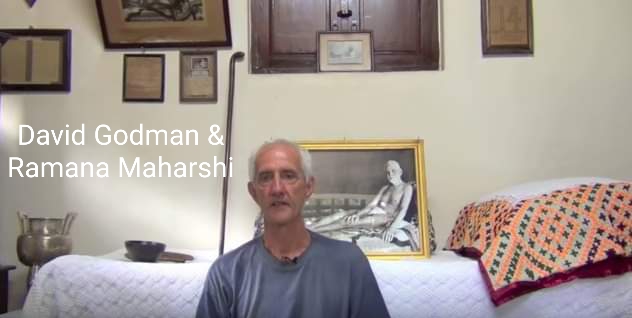
David Godman (his family’s actual surname) read a book in 1974 about the great sage and jnani, Sri Ramana Maharshi, and two years later traveled to his ashram in India. Since then, he has lived almost continuously in Tiruvannamalai, the town where Sri Ramana spent all his adult life. He now lives in a home he built about two miles from the base of Sri Ramana’s beloved Arunachala, a holy mountain in South India. David has published thirteen books on Sri Ramana Maharshi, his teachings and his direct disciples, and shares the inspiration and wisdom of the Jnana Yoga of Sri Ramana with our readers in this interview.
(photo: David Godman speaking from Sri Ramana’s room in India)
Integral Yoga Magazine: How did you first become interested in the teachings of Sri Ramana Maharshi and go to India?
David Godman: In the mid-1970s, I read Arthur Osborne’s The Teachings of Ramana Maharshi in His Own Words. Reading Sri Ramana’s words for the first time completely silenced me. My mind stopped asking questions and abandoned its search for spiritual information. It wasn’t that I had found a new set of ideas to believe in. It was more of an experience in which I was pulled into a state of silence. In that silent space, I knew directly and intuitively what Sri Ramana’s words were hinting and pointing at. I spent about a year reading the teachings and practicing the technique of self-inquiry, mostly in Ireland, and then, in early 1976, I decided to go to India to visit Sri Ramana’s ashram. I spent my first eighteen months here just meditating, practicing self-inquiry and occasionally walking round Arunachala. In 1978 I began to do voluntary work for Sri Ramanasramam. I looked after their library from 1978 to 1985, edited their magazine for a short period of time and, from 1985 onward, did research for my various books.
IYM: Are there books on Ramana Maharshi you would recommend for a beginner?
DG: When I compiled Be As You Are: the Teachings of Sri Ramana Maharshi I specifically targeted westerners who had never heard about Sri Ramana, and who knew little or nothing about the Hindu tradition and its terminology. Anyone in that category should find this book a good place to start. For a good introduction to Sri Ramana’s life, I would recommend Arthur Osborne’s Ramana Maharshi and the Path of Self Knowledge. For those who want more, I can suggest some of the primary texts in which Sri Ramana’s teachings were recorded by those who were listening to him. Talks with Sri Ramana Maharshi, Day by Day with Bhagavan, and Maharshi’s Gospel are good places to start.
IYM: Would you tell us something about Sri Ramana’s own spiritual journey?
DG: He had a normal, ordinary childhood in which he exhibited little or no interest in spiritual matters. At the age of sixteen he had a spontaneous awakening, attaining complete and full enlightenment when a sudden and unexpected feeling that he was about to die prompted him into a spontaneous act of self-inquiry. He told no one what had happened to him, but about six weeks later he left home, without telling his family, and headed for the sacred mountain of Arunachala. He spent the rest of his life there.
In one of his poems, composed years later, he wrote, “From my unthinking childhood the immensity of Arunachala had shone in my awareness.” He didn’t know in his childhood that it was a place he could go to; he just had this association with the word Arunachala. He felt, “This is the holiest place, this is the holiest state, this is God himself.” For many years he was in awe of Arunachala and what it represented, without ever really understanding that it was a place of pilgrimage he could actually go to. After his enlightenment experience, he understood that it was the power of Arunachala that had precipitated the experience and pulled him physically towards it. In that same poem I just quoted from he also wrote, “When it [Arunachala] stilled my mind and drew me to itself and I came near, I saw that it was stillness absolute.” This contains a very nice pun. “Achala” is Sanskrit for “mountain” and it also means “absolute stillness.” This poem describes Sri Ramana’s physical pilgrimage to Arunachala, but in another sense he is talking about his mind going back into his heart and becoming totally silent and motionless.
IYM: Many associate the question, “Who am I?” with Sri Ramana’s teachings. Was this the main teaching?
DG: He always maintained that his primary and most effective teaching was the silence that radiated from him on account of his Self-abidance. It stilled the minds of the people who were fortunate enough to be with him and, on occasion, it even gave them a taste of the direct experience that he himself was experiencing all the time. The words, the spoken teachings and the various methods he advocated were for those people who were unable to attune themselves to these silent emanations.
I would say that self-inquiry, telling people to ask themselves, “Who am I?,” was his most distinctive teaching insofar as it was a new and innovative path that no one else had taught before, but I would not even say that it was his main verbal teaching. He spent a lot of time telling people, “You are the Self. The Self is already realized. Just be it,” but of course no one believed him. Instead, they would say, “Yes, but that’s not my experience. What do I do to attain it?” When people spoke to him like this, he would often ask them to do self-inquiry.
IYM: Can you explain the technique of self-inquiry?
DG: The key to understanding self-inquiry is Sri Ramana’s assertion that the individual “I” can only exist in association with the thoughts and perceptions that it latches onto. In “I am angry,” “I see a tree,” “I am a lawyer,” there is a subject “I” who is associating with an object of thought or perception. Sri Ramana taught that, when these associations cease completely, “I” itself disappears. He said that if one could put one’s attention exclusively and continuously on the subject “I,” without being distracted by any extraneous thoughts, this “I,” the sense of individuality, would subside into its source and vanish, leaving an awareness of the Self that is unmediated by any sense of being an individual person.
It’s all about redirecting attention. When you become aware that your mind is directing itself to other thoughts, objects that are not the “I,” he suggested asking, “To whom do these thoughts or things appear?” The answer is, of course, “To me.” Then, having switched attention from objects of thought to the perceiver or thinker of them, Sri Ramana says, “Ask yourself, ‘Who am I?’ or, ‘Where does this “I” come from?’” This process, done repeatedly, de-conditions the “I” from its habit of always looking for and associating with external perceptions, thoughts and ideas. Eventually, when the “I” no longer feels impelled to catch hold of stray thoughts and indulge in them, it simply vanishes since it cannot exist free of associations. If I may summarize: The practice of self-inquiry is unremitting attention to one’s inner feeling of “I.”
IYM: For those who may find this challenging or a bit abstract, are there any helpful hints you could share?
DG: Sri Ramana had a very appropriate analogy for this process. Imagine that you have a bull, and that you keep it in a stable. If you leave the door open, the bull will wander out, looking for food. It may find food, but a lot of the time it will get into trouble by grazing in cultivated fields. This is an Indian story. Here, there are no boundary fences, so cattle can wander anywhere in search of food. The owners of the fields our bull wanders into will beat it with sticks and throw stones at it to chase it away, but it will come back again and again, and suffer repeatedly, because it doesn’t understand the notion of field boundaries. It is just programmed to look for food and to eat it wherever it finds something edible.
The bull is the mind, the stable is the Self where it arises and to where it returns, and the grazing in the fields represents the mind’s painful addiction to seeking pleasure in outside objects. Sri Ramana said that most mind-control techniques forcibly restrain the bull to stop it from moving around but they don’t do anything about the bull’s fundamental desire to wander and get itself into trouble. You can tie up the mind temporarily with japa (repetition of sacred names) or pranayama (breath control), but when these restraints are loosened, the mind just wanders off again, gets involved in more mischief and suffers again. You can tie up a bull, but it won’t like it. You will just end up with an angry, cantankerous bull that will probably be looking for a chance to commit some act of violence on you.
Sri Ramana likened self-inquiry to holding a bunch of fresh grass under the bull’s nose. As the bull approaches it, you move away in the direction of the stable door and the bull follows you. You lead it back into the stable, and it voluntarily follows you because it wants the pleasure of eating the grass that you are holding in front of it. Once it is inside the stable, you allow it to eat the abundant grass that is always stored there. In this way you train it to stay home. The door of the stable is always left open, and the bull is free to leave and roam about at any time. There is no punishment or restraint. The bull will go out repeatedly, because it is the nature of such animals to wander in search of food, but every time you notice that your bull–mind has wandered out, tempt it back into its stable with the same technique. Don’t try to beat it into submission or you may be attacked, and don’t try to solve the problem forcibly by locking it up. Sooner or later even the dimmest of bulls will understand that, since there is a perpetual supply of tasty food in the stable, there is no point wandering around outside, because that always leads to suffering and punishments. Even though the stable door is always open, the bull will eventually stay inside and enjoy the food that is always there.
IYM: What can we do if the mind continues to wander?
DG: Whenever you find the mind wandering around in external objects and sense perceptions, take it back to its stable, which is the heart, the Self, the source from which it rises and to which it returns. In that place it can enjoy the peace and bliss of the Self. When it wanders around outside, looking for pleasure and happiness, it just gets into trouble—but when it stays at home in the heart, it enjoys peace and silence. Eventually, even though the stable door is always open, the mind will choose to stay at home and not wander about. Sri Ramana said that the way of restraint was the way of the yogi. Yogis try to achieve restraint by forcing the mind to be still. Self-inquiry gives the mind the option of wandering wherever it wants to, and it achieves its success by gently persuading the mind that it will always be happier staying at home.
IYM: What about Self-realization?
DG: Though it is not part of Sri Ramana’s analogy of the bull, we can extend this story to cover other parts of his teaching. For realization, for a true and permanent awakening, the bull has to die. While it is alive, and while the door is still open, there is always the possibility that it will stray. If it dies, though, it can never be tempted outside again. In realization, the mind is dead. It is not a state in which the mind is simply experiencing the peace of the Self. When the mind goes voluntarily into the heart and stays there, feeling no urge whatsoever to jump out again, the Self destroys it and Self alone remains.
This is a key part of Sri Ramana’s teachings: The Self can only eliminate the mind when the mind no longer has any tendency to move outwards. While those outward-moving tendencies are still present, even in a latent form, the mind will always be too strong for the Self to dissolve completely. This is why Sri Ramana’s technique works and the forcible-restraint way doesn’t. You can keep the mind restrained for decades, but such a mind will never be consumed by the Self because the desires, the tendencies, the vasanas, are still there. They may not be manifesting, but they are still there. Ultimately, it is the grace or power of the Self that eliminates the final vestiges of the desire-free mind. The mind cannot eliminate itself, but it can offer itself up as a sacrifice to the Self. Through effort, through inquiry, one can take the mind back to the Self and keep it there in a desire-free state. However, mind can’t do anything more than that. In that final moment, it is the power of the Self within that pulls the last remains of the mind back into itself and eliminates it completely.
About David Godman
For the past five years David Godman and two colleagues have been translating Tamil texts in which Muruganar, one of Sri Ramana’s leading devotees, recorded Sri Ramana’s teachings. Some of the teachings were published in 2003 in a book called Padamalai; the remainder is in a work entitled Guru Vachaka Kovai. They also translated the devotional poems of Guhai Namasivaya, a saint who lived on Arunachala about five hundred years ago.
Whatever remains -NM
YOU ARE THE PRIOR-MOST,
… YOU ARE THE ABSOLUTE !
Visitor: To meditate on that which comes after the Beingness.
The only way I see it; is to watch what remains, when everything is gone. When time, space, and everything disappears, what remains?
Nisargadatta Maharaj: When the manifest world of the three gunas is gone, whatever remains indicates what you were a hundred years ago, and prior to your birth.
In that state, ‘You’ were bereft of the three states of; waking, deep sleep, and Knowingness.
You should abide in that state during meditation.”
V: How does one avoid going into Samadhi, in this meditation?
N.M: Going into Samadhi or coming out of Samadhi are not your qualities. You are beyond qualities.”
V:My question is how to avoid it.
N.M: Going into, and coming out of, Samadhi, are qualities like all other qualities of the three gunas, and do not try to avoid Samadhi.
It is the natural play of the three gunas. Samadhi will be there, but ‘You’ – The Absolute, are not in the Samadhi.”
(Thank you, Maria Jory)
Who am I?
“WHO AM I ?”
Advaita:
‘Self- Inquiry’ Meditation Technique
(Source: Unknown)
“I am not the imaginary ‘i’; the ego, my name. I am not the temporary ‘i’ – my body, or my mind.
I AM The Everlasting Life force, behind all living beings. I am the source of Universal Love and Happiness. Aham Brahamasmi – ‘I AM’, Brahman.”
- Advaita Self-Inquiry Meditation:
Technique for Beginners
Advaita Self Inquiry Meditation is a 5000 year old Meditation technique, explained in the teachings of Sri Adi Sankara, Sri Ramana Maharshi, and Sri Nisargadatta Maharaj, and in the Spiritual Texts: Upanishads, Bhagavad Gita, and Yoga Vasistha.
Advaita Self Inquiry Meditation, is superior to other types of Meditation; as it results in permanent transformation, and helps you manage your emotional vulnerabilities like anger, stress and anxiety, through out the day, and is not something that you benefit only during the short period of meditation. The meditation technique brings empathy and Compassion towards all living beings.
In Advaita Self Inquiry Meditation you begin the meditation with a simple question, ‘Who am I?’
The goal of the three stages of Advaita meditation technique is to go beyond your ‘Body’ (Stage One), and ‘your Mind that generates thoughts’ (Stage Two), and stay in the Meditative Stage of ‘Thoughtless Mind’ or ‘Breath Awareness’; called Consciousness (Stage Three).
Each time you slip from Stage Three to Stage Two or Stage One, follow the technique to progress to the ‘Meditative Stage – Stage Three’. Try to stay in ‘Stage Three’ atleast for a few minutes initially. Slowly with daily practice you can stay in ‘Stage Three’ for 15-20 minutes and more.
Read through the instructions below : Stage One to Stage Three. When you are ready, sit in a comfortable posture, close your eyes and inquire within and try to move from Stage One to Stage Three and stay in Stage Three as long as possible.
Stage One : You are not the Body.
Start by asking yourself a simple question, ‘Who am I?’ Am i the body? Is my body permanent? What happens to my body after death? Your body is not permanent as it goes through the stages of birth, adulthood, old age and disintegrates after death. So you are not the body. If I am not the body, then ‘Who am I’?
Stage Two : You are not the Mind with all its thoughts
Am I the mind, that generates the thoughts or desires? When a thought or desire arises during meditation ask a question, To whom do the thoughts or desires come for?
The answer to the question is that, all thoughts or desires come to serve ‘i’ – the ego, your name’ the imagination of who you are.
‘i’ – the ego, is the first imaginary thought, created by the mind, and all other subsequent thoughts, come to serve the first imaginary thought ‘i’ – the ego, your name; the imagination of who you are.
When you say in meditation, there is no ‘i’ – ego, your name, your thoughts or desires, have no one to serve, and they immediately die.
The moment you say this, all thoughts that arise during meditation disappear. Each time a thought arises, keep saying this to get rid of the thought.
Imagine your ‘i’ – the ego, your name’, as an imaginary bubble that you have created, and all other thoughts that arise are bubbles that attach to the imaginary bubble – ‘i’ – the ego’.
When the bubble ‘i’, the ego – your name’ bursts, all other thought bubbles that come to serve ‘i’ – the ego, your name’, also burst and disppear.
You are left in a state of thoughtless calm mind.
If you are not the mind, with all of its thoughts then – ‘Who am I’?
Stage Three: Stay in the thoughtless Meditative state of ‘Breath-Awareness’ or ‘Consciouness’
You are not the body, that disintegrates after death. You are not the mind, that generates thoughts to serve ‘i’ – the ego, your name, the imagination of who are. If you are not the Body or the Mind, then ‘who are you’?
The Breath Awareness, or The Life florce, that swells in your heart – in a state of thoughtlessness, is ‘Consciousness’, or ‘God Awareness’.
Your fascination with the body and mind had hidden this from you.
‘Consciousness’ is all that is. You are nothing but Consciousness. Stay in the Meditative State as long as you can. If you are Consciousness then all the living beings around you are also Consciouness. Universal Love and Compassion is your True Nature. 🌹”
(Thank you, Karl Natal)
Are you screen or images? RAdams -RSpira
ARE YOU THE SCREEN,
… OR THE IMAGES ON THE SCREEN ?
“All of life experiences, are images on the screen of Eternity.
The screen is Real.
The images change.
‘Consciousness’ is the screen.
When you identify with Consciousness, you become Consciousness.
When you identify with the image, you enhance the image, and you worry, and fret, and fear, and you have all sorts of experiences.
As soon as you begin to identify with Reality – with Consciousness;
all fear leaves you – all doubt leaves you, all false thinking leaves you, and you become Free.
But that’s the only Free Choice you get. Everything else has been preordained.
The Free Choice – again is:
with what are you going to identify; with the image, or the screen?”
~Robert Adams ~
In The Void-rjs
IN THE VOID
There is …
No thing.
There’s no we
No you, no me
There’s nothing.
All around
Wherever I look
I see abject
Nothingness
And I breathe.
Senses are still
Mind dissipated.
Splendor and joy
Sublime love
Nothing to do
But weep.
This is it!
Blissful solitude!
Peace unshakeable
Joy and contentment
Beyond forever
In the Void.
DrRobinStarbuck.com

THE SELF & CONSCIOUSNESS
THE SELF & CONSCIOUSNESS
What is the Self?
The Self is your real nature, that’s what you are. The Self is consciousness.
What is consciousness?
Consciousness is the power that is conscious of itself. It is self-contained, it is omnipresent. When you speak of love, of peace, of God, of joy, of happiness, of bliss, you’re speaking of consciousness. These words are just other words for consciousness. Consciousness is you. The Self, consciousness, they’re all synonymous. They all pertain to you.
Now what have you been seeing? What have you been reacting to?
The mind goes out and causes problems and you try to resolve them. You cannot.
For when you resolve one problem another one pops up somewhere else and there’s no end to it. It’s like trying to figure out, what came first the seed or the tree? You never get anywhere, there’s no solution. People have been trying to resolve problems, since the beginning of time and the world is getting worse. There’s no adequate solution in trying to resolve anything in the outside. The great secret of course is to;
Leave the world alone, go within your Self and there you will find happiness, joy and peace.
But how do you go within yourself? How do you dive deep within yourself?
By asking the question, “Who am I?”
I have found this to be the fastest method there is, to awakening. There are other methods, but personally I found this the fastest. All you have to do is question, “Who am I?” You do not have to answer, you do not have to analyze anything, you do not have to come up with any solution. You simply ask the question,
“From whence did I come? Where did the I come from? What is the source of I?”
Many people have been practicing Jnana Marga have made the mistake of concentrating on the I and this is why you do not get anywhere. You concentrate on the source, not on the I. The I is only an illusion. It is only something that appears to be like your body. It has no momentum, it has no substance. But yet you have to watch the I. You have to abide in the I. For it leads you to the source of existence. The source of everything.
ROBERT ADAMS
Transcript 29, p. 416
More On Satsang
9th December, 1990
Robert Adams Satsangs
The Collected Works