When your mind starts thinking, thinking, thinking, thinking, thinking about good and bad, yousimply ask the question,
“To whom do these thoughts come?”
You do not answer you simply pose the question to yourself.
Everything happens within yourself.
“To whom do these thoughts come?” The answer will eventually come to you. “These thoughts come to me. I think them. I think them? I do? Who is this I. Well what is the source of the I?” You hold on to the I, but you do not concentrate on the I, you concentrate on the source.
“Well what is the source of the I.” For it seems that all of my problems are attached to I.
For I say, “I feel bad. I feel upset. I feel angry. I feel cheated. I feel emotional,” or even “I feel good. I feel
happy,” that’s human happiness.
You feel happy because somebody gave you something you like or somebody did something for you.
That’s just as bad as feeling depressed.
I feel this and I feel that, I feel that I am a Jnani, I feel that I am not a Jnani, I feel all kinds of things.
But there’s always I, I, I.
If you investigate you will find that everything is attached to the I. And if you get rid of the I, all of your problems, the whole world, the whole universe, God and everything related to it, will disappear.
And the source will be your true Self which is pure consciousness, ultimate oneness, nirvana, emptiness.
This is your true Self.
And you will look at the world as your Self.
You will still see the world but you will see it differently. Nothing will ever upset
you again. For you will realize that the world is your Self.
How can you be upset at your Self?
You have become an embodiment of divine love, bliss, pure intelligence, ultimate
awareness, sat-chit-ananda, parabrahman, that is omnipresence.
So how can you be angry or upset over anything if you are pure consciousness, you just cannot.
Do you see what I’m saying?
If you learn to identify yourself with consciousness, you will always be happy. If you keep identifying with world conditions or with your body or your mind, you will be miserable and you’ll have short spurts of happiness, when things go your way. But then you will not trust people.
You will be suspicious of everybody’s motives and you will feel that there’s something wrong.
If you want to know whether you’re a Jnani or not, ask yourself,
“When was the last time I saw something wrong?
When was the last time something wasn’t right when I had a bad thought when I believed somebody was doing some-
thing to me, or when I became angry,” and that will give you a good inclination where
you’re coming from.
What you see in yourself, you see in everyone else. If you’re self-realized, then you know your Self as omnipresence and you can only see love, peace, harmony and happiness in everybody.
The choice is yours.
The only freedom you’ve got on this planet, in this universe, is to make the choice to go within and not to react to any condition.
Everything else about you is preordained. Everything else about you is prarabdhic
karma. Even when I lift my hand like this, it’s karmic. But what have I got to do with my hand? I am not my hand, I am not my body, I am not my mind, I-am that I-am. Absolute awareness, pure intelligence, absolute reality, parabrahman, nirvana.
I am spaceless, I am birthless, I am deathless. Water cannot drown me and fire cannot burn me. That is my true nature.
Find your true nature my friends and you’ll always be happy. Om shanti.
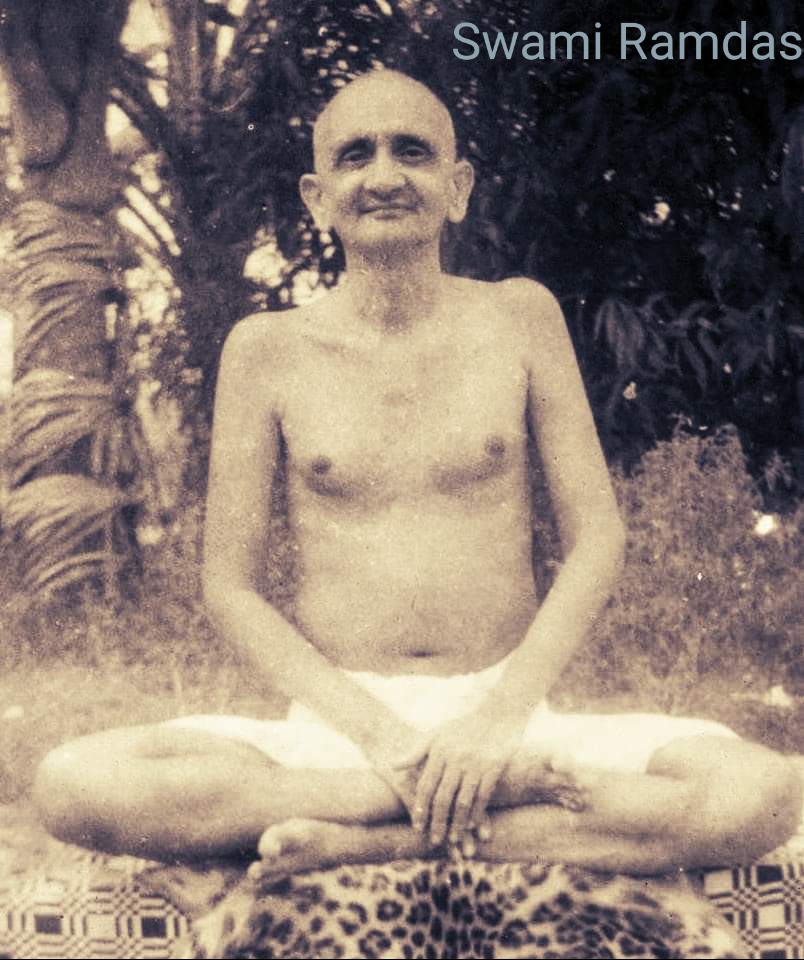
“The path of pure and simple Bhakti(Devotion) is one of the easiest means to reach the all-powerful feet of the Lord. Self-surrender is the goal. Pure aspiration and ceaseless meditation constitute the path. All else is secondary.”
— Swami Ramdas
Good morning, afternoon Anandashram thought for the day
“God is absolute existence, knowledge and bliss. If He is an object of knowledge, He cannot be real and He cannot be eternal.
Because He is self-existent and self-luminous, He is not an object of knowledge. Every object of knowledge is perishable.
The mystics say much about Him, but whatever they say cannot be totally He. Therefore, in the Upanishads it is said that He is not what you think of, He is not what you talk about.”
— Swami Ramdas
Good morning Anandashram thought for the day
“Mystics have a sense of beauty. Those who have got the talent for music, sculpture, art, etc., when they become mystics, express their exalted and holy emotions through art, music or sculpture. You will find great poets among mystics in India and other countries. They have revealed their spiritual genius through their particular talents. The mystics are in tune with nature, and through nature with God. When they stand before the vastness of a landscape, the greenness of a forest, the scintillating expanse of the blue water of the ocean, the golden hue of the sunrise and sunset, they go into a trance and feel the hallowed presence of the Most High. In ecstasy they pour out their hearts in celestial rhapsodies and songs. They love solitude where they converse with God.”
In Hinduism, and in particular Jnana Yoga and Advaita Vedanta, neti neti is a Sanskrit expression which means “not this, not this”, or “neither this, nor that” (neti is sandhi from na iti “not so”). It is found in the Upanishads and the Avadhuta Gita and constitutes an analytical meditation helping a person to understand the nature of Brahman by first understanding what is not Brahman. It corresponds to the western via negativa, a mystical approach that forms a part of the tradition of apophatic theology. One of the key elements of Jnana Yoga practice is often a “neti neti search.” The purpose of the exercise is to negate rationalizations and other distractions from the non-conceptual meditative awareness of reality.
Significance of neti neti
Neti neti, meaning, “Not this, not this”, is the method of Vedic analysis of negation. It is a keynote of Vedic inquiry. With its aid the Jnani negates identification with all things of this world which is not the Atman, in this way he negates the Anatman. Through this gradual process he negates the mind and transcends all worldly experiences that are negated till nothing remains but the Self. He attains union with the Absolute by denying the body, name, form, intellect, senses and all limiting adjuncts and discovers what remains, the true “I” alone.[1] L.C.Beckett in his book, Neti Neti, explains that this expression is an expression of something inexpressible, it expresses the ‘suchness’ (the essence) of that which it refers to when ‘no other definition applies to it’.[2] Neti neti negates all descriptions about the Ultimate Reality but not the Reality itself. Intuitive interpretation of uncertainty principle can be expressed by “Neti neti”[3] that annihilates ego and the world as non-self (Anatman), it annihilates our sense of self altogether.[4]
Adi Shankara was one of the foremost Advaita philosophers who advocated the neti-neti approach. In his commentary on Gaudapada’s Karika, he explains that Brahman is free from adjuncts and the function of neti neti is to remove the obstructions produced by ignorance. His disciple, Sureshvara, further explains that the negation, neti neti, does not have negation as its purpose, it purports identity.[5] The sage of the Brihadaranyaka Upanishad II iii 1-6, beginning with there are two forms of Brahman, the material and the immaterial, the solid and the fluid, the Sat ‘being’ and tya, ‘that’ of Satya – which means true, denies the existence of everything other than Brahman. And therefore, there exists no separate entity like Jiva which Shankara states is the reflection of Brahman in Avidya (ignorance).[6
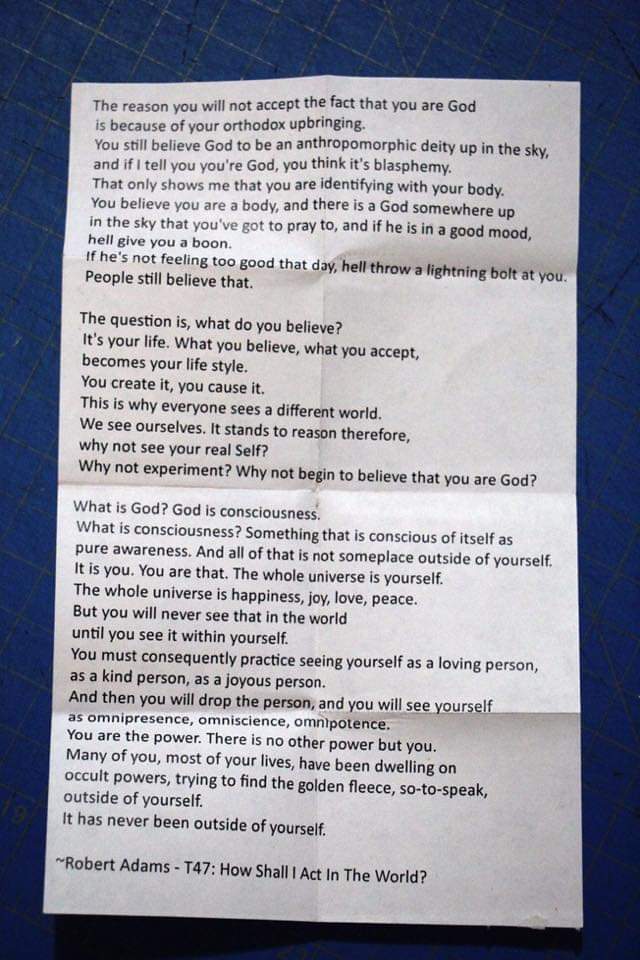
“The person is not God, the body is not God, but you are God. The reason you will not accept the fact that you are God is because of your orthodox upbringing. You still believe God to be an anthropomorphic deity up in the sky, and if I tell you you’re God, you think it’s blasphemy. That only shows me that you are identifying with your body. You believe you are a body, and there is a God somewhere up in the sky that you’ve got to pray to, and if he is in a good mood, he’ll give you a boon. If he’s not feeling too good that day, he will throw a lightning bolt at you. People still believe that. The question is, what do you believe? It’s your life. What you believe, what you accept, becomes your lifestyle. You create it, you cause it. Why not experiment? Why not begin to believe that you are God? What is God? God is consciousness. What is consciousness? Something that is conscious of itself as pure awareness. And all of that is not some place outside of yourself. It is you. You are that. The whole universe is yourself. The whole universe is happiness, joy, love, peace. But you will never see that in the world until you see it within yourself. You must consequently practice seeing yourself as a loving person, as a kind person, as a joyous person. And then you will drop the person, and you will see yourself as omnipresence, omniscience, omnipotence. You are the power. There is no other power but you. Many of you, most of your lives, have been dwelling on occult powers, trying to find the golden fleece, so-to-speak, outside of yourself. It has never been outside of yourself. Everything you’re looking for is within you. Stop searching outside of yourself. Everything you want is within you. The potential, the possibility for everything you can imagine is within you. The omnipresent Self is your real nature.” ~ Robert Adams
Every negative condition you see in the world is a lie. Every positive condition you see in the world is a lie. Reality is beyond positive and negative. Why do you see these things? Why do you worry and fret about your life or about the life of someone else?
What can possibly happen to you? Where can you go? Who suffers? Only the body-ego-mind suffers. To the extent that you can realize that you are not the body-ego-mind, to that extent do you become totally, absolutely free.
You take a look at yourself.
Look at the way your thoughts have been ruling you, keeping you in bondage to them, how your thoughts have caused you to fear, to be suspicious, to be doubtful, to be apprehensive, to worry, and you
begin to do the work.
As long as the thoughts keep coming, you have to ask the question
“To whom do they come?”
That’s how it all begins.
Forget about the world.
Forget about everything.
I know some of you are saying already
“If I forget about everything, how will it get done?”
As I explained to you before,
before you were born everything was already laid out, and your body is going to go through the experiences it has to go through, yet it has absolutely nothing to do with you.
So forget about that.
Deal with the thing at hand.
It meant first that your thoughts control you completely, and it’s hard for you to get away from them.
Then you start to work by inquiring
“To whom do they come?”
Whatever thoughts come to you, you pose the same question. It makes no difference whether the thoughts are good or bad.
Some of you are still believing that to pose the question “To whom does this come?” is only for bad thoughts, or when things are not going your way.
On the contrary. All thoughts are erroneous. No matter what kind of happy thoughts come to you, no matter what thoughts come to you that are horrible, you have to ask
“To whom do they come?
To whom do they come?
They come to me. I feel them. Since I can think about I, I must be separate from
myself, and all of my thoughts are threaded on the I.”
You therefore follow the I thread to the source, realizing all the time that you are not I. You become the witness to I.
That alone makes you feel wonderful, for you begin to realize that your real nature is freedom.
It is I who has the problems.
It is I who has the apprehension, the suspicions, the anger, the fears, the frustrations, the needs, the wants,
the desires, are all attached to I.
It is even I that wishes to become self-realized.
Watch the I.
Abide in the I.
Just by abiding in the I do thoughts begin to become weaker. When more thoughts come, you inquire again “To whom do they come?” and you realize they belong to the personal I. At this time, when you’re witnessing the I, do not inquire “Who am I?” but spend the time witnessing the I.
As further thoughts interrupt you, again inquire “To whom do they come?” Again “They come to me, to I.” Again
feel and realize that my real nature is safe and secure. It is I who has the problem. When you come to this realization
after a while, you then can inquire “Who is this I? Who am I?” Remember when you’re saying “Who am I? you’re
not talking about your real nature, who does not experience problems. You’re referring to your personal I, that is
separate and apart from you.
Where did this I come from?
Who gave it birth?
If you do this correctly, everything will come by itself. You will begin to feel and realize your self. “When I slept, I
was not bothered by I. When I dreamt I was not bothered by I. But now that I woke up, I is born. Who gave it birth?”
This kind of inquiry will cause something beautiful to happen to you. You will begin to feel that no one gave the I birth.
It never existed to begin with.
I know some of you still believe that consciousness, or the self, gave the I birth. How could this be? Consciousness,
the self, is all-pervading. It takes up all space. There’s no room for anything else. In other words, there cannot be
consciousness and you, or consciousness and I, or consciousness and the world, because there’s just no room. There
never was room for you and I. This will be a new revelation for you. You will awaken simply by realizing this great
truth.
When I say you look for the source of I, the source of I is nothing. It comes from no thing. But you will ask the question “Then why did it come at all?” And the answer is, it didn’t. The I exists like your body exists, like your mind exists, like the world exists, like the universe exists, like God exists. All of that is I. If none of these things
exist, neither does the I.
The important point to remember is, when you’re playing with the I, do not identify the I with the body or with yourself. Keep the I separate. Realize that your body is attached to the I, the universe is attached to the I, but the I does not exist. Nothing gave it birth. That’s why as I opened up the lecture tonight, I said your true nature is nothing.
You are plain nothing. You are no thing. No thing, nothing is consciousness, absolute reality, pure awareness. It is Parabrahman, it is beyond Brahman, and you are that. It begins and ends with you.
What do you do with all of your time during the day? There is no such thing as you’re too busy to practice self- inquiry. This should come first in your life, because this is your life. Everything else is secondary. If this appears too cdifficult for you in the beginning, surrender everything to God.
Let God take care of everything for you. Say something like this “God, self-inquiry is too heavy for me right now. I seem to go nowhere with it. But I surrender to
you my emotions, my body, my anger, my fears, my frustrations. I surrender the universe, the world. Everything that I believe I surrender to you. Take it and do as you will with me. I am only a puppet for you. Play with me as you desire,” and leave it at that.
As you keep on surrendering every day, twice a day, three times a day, just by that alone fear will leave you. Your frustrations will leave you. Your mind will not concentrate on your body. It will become
weaker just by surrendering.
The choice is yours. Do what you must. But remember, to go on playing the game of life will only lead you to more life, more births, more deaths, more frustration and more ignorance.
Realize the truth about yourself, and become free.
The Collected Works of Robert Adams Volume 1, page 248-249
FREEDOM FROM THOUGHTS We all live two separate, or dual, lives in our thinking and in our experiencing. If and when we’re free of thoughts, we get to experience the present in its blissful, serene and pristine purity! DrRobinStarbuck
AdvaitaThe nondualistic school of Vedanta philosophy that affirms the oneness of the individual soul, God, and the universe.
AranyakasThat section of the Vedas which gives a spiritual interpretation to the ritualistic portion of the Vedas. It is also called the “forest treatises” because it was originally intended for ascetics who lived in the forests.
Ashrama or AshramA center of spiritual study or meditation. A retreat, hermitage, or monastery.
AshtavakraThe sage who authored the Ashtavakra Samhita.Ashtavakra SamhitaA classic text on Advaita Vedanta.
AtmanThe divine Spirit in man, the Self which is one with Brahman, the all-pervading divine existence, the Ground of the universe.Avadhuta GitaA classic text on Advaita Vedanta.AvatarAn incarnation of God.AvidyaIgnorance, individual or cosmic, which hides the nature of the supreme Reality from our view.BadarayanaAuthor of the Brahma Sutras. Little is known of him, though tradition identifies him with Vyasa, the author of the Mahabharata, who lived in India somewhere between 500 and 200 B.C.
Bhagavad GitaLiterally the “Song of God,” the Gita is one of the most revered scriptures of Hinduism, and consists of 700 verses.
BhaktiLove of God.Bhakti yogaUnion with God through the path of loving devotion.BhasyaA commentary.
BrahmanThe absolute Reality, the Unity of all that exists, the formless, attributeless Godhead.
Brahma SutrasAlso known as the Vedanta Sutras. A treatise by Badarayana on Vedanta philosophy which interprets the Upanishads, and discusses the knowledge of Brahman.BuddhiIntelligence or discriminating faculty which classifies sense impressions.ChakraOne of the six centers of consciousness located along the spinal column.ChandiAlso known as the Devi Mahatmyam.
The Chandi is a sacred Hindu scripture which praises the Divine Mother of the universe, identifying her as the ultimate Reality.
DeviLit., “goddess.” The word can refer to any female deity in Hinduism.
DharmaRighteousness, truth, or religious duty.Dhruva (or Dhruba) smritiThe state of constant recollectedness of God.DhyanaMeditation or prolonged concentration.DurgaAn aspect of the Divine Mother of the universe, the consort of Shiva. Durga is generally represented with ten arms, seated on a lion. She is the protectress of the universe, destroying the demons of ignorance and giving the blessings of divine love and knowledge.GunaLit., “quality.” In Hindu philosophy there are three gunas which constitute prakriti, or nature: sattva, rajas, and tamas. Tamas is characterized by dullness, stupidity, inertia; rajas by activity, restlessness, and passion; sattva by calmness, purity, and wisdom. These three qualities are found in varying proportions in the external world and in all created beings.GuruSpiritual teacher.IshtaThe spiritual aspirant’s chosen ideal of God.IshvaraThe personal aspect of God; God with attributes.
JanakaA famous king who was both a knower of Brahman as well as the ruler of his kingdom, Videha.JapaRepetition of the Lord’s name, usually one’s own mantra.
JnanaKnowledge of the ultimate Reality, attained through the process of reason and discrimination between the real and the unreal.
Jnana yogaPath of union with the ultimate Reality through spiritual knowledge and discrimination between the real and the unreal.JnaniOne who follows the path of knowledge by discriminating between the eternal and the transitory.KaliOne of the aspects of the Divine Mother of the universe. Kali was Ramakrishna’s Chosen Ideal, and he worshiped her image at the Dakshineswar temple for many years. Kali is usually shown standing on the chest of her consort, Shiva. Around her waist she wears a garland of human arms, and around her neck a garland of human heads. She has four arms: the lower left hand holds a human head, her upper hand grips a saber. With one right hand she offers boons to her children, and with the other she makes the sign that dispels fear. She deals out death as she creates and preserves. Kali destroys ignorance, preserves world order, and gives blessings and liberation to those who earnestly seek it. While Shiva represents the Absolute, Kali represents the dynamic, or relative aspect of the Supreme Reality.KarmaAction, both physical and mental, and the effects of action.Karma yogaPath of union with God through selfless activity.KarpanyaThe feeling of helplessness; self-surrender.Lokacharya, PillaiTwelfth-century Vaishnava philosopher and writer who held that God’s grace is spontaneous; it was to be sought not only through bhakti, devotion, but also through total self-surrender.MadhvaThe twelfth-century exponent of dualistic Vedanta. He wrote commentaries on the Brahma Sutras, the Upanishads, and the Bhagavad Gita.
MahamayaThe Mother of the universe, the divine will. Mahamaya veils our vision of Brahman, the absolute Reality. Yet through her grace, she rends this veil, allowing us to realize the identity of the Atman with Brahman.MahavakyaLiterally, “great saying.” A Vedantic formula that declares the oneness of the individual soul with Brahman.MananaThe process of reasoning in which one reflects on the spiritual teacher’s words and meditates upon their meaning.MantraThe sacred name of God given by the guru to the disciple. Repetition of the mantra is japa.MargaPath; jnana marga, for example, is the path of spiritual knowledge, and bhakti marga is the path of devotion.MayaMaya is the power of Brahman, the creative aspect of God. It is also the cosmic illusion that creates ignorance and veils the vision of Brahman. Due to the power of maya, Brahman, the one Reality, is perceived as the manifold universe.NididhyasanaDeep meditation on the truth of Brahman.Nirvikalpa samadhiLit., “changeless samadhi.” The highest state of realization in which the spiritual aspirant attains oneness with the Absolute.
OmThe most sacred syllable of Hinduism; the sound-symbol of Brahman.
PrakritiPrimordial nature; the material principle of the world which, in association with Purusha, creates the universe. Prakriti is one of the two ultimate realities of Sankhya philosophy.PranaIn the physical body, prana is the vital breath that sustains life and manifests as thought, bodily function, and physical action. In the cosmos, prana is the sum total of all primal energy that manifests as motion, gravitation, magnetism, etc.PrarthanaPrayer.PratyaharaWithdrawal of the mind from the objects of the senses.
PravrajikaTitle of women who have taken final vows of renunciation, or sannyas. (The corresponding word for men is swami.) The term generally means a woman ascetic.PujaRitualistic worship.PurushaOne of the two ultimate realities of Sankhya philosophy. The divine Self, the absolute Reality, pure Consciousness.Raja yogaLiterally the “royal yoga,” raja yoga is the path of meditation. It is the spiritual path by which one attains union with the Absolute through control of internal and external forces.RajasThe guna which expresses itself as restlessness, activity, and passion.Ramakrishna, Sri(1836-1886) A God-man of India who is considered by many to be an incarnation of God. His message stressed the essential unity of all religions, the innate divinity of humanity, and the realization of God as the goal of life.RamanujaThe eleventh-century saint-philosopher who propagated the school of qualified nondualism, Vishishtadvaita. Ramanuja wrote commentaries on the Brahma Sutras and the Bhagavad Gita, along with other original treatises which advocated his philosophy of devotion to God as the highest ideal of human life.RamprasadEighteenth-century Bengali mystic and poet. He composed devotional songs to Kali which Ramakrishna loved to sing.RishiA seer of spiritual truth. Usually the term refers to the ancient Hindu seers to whom the Vedas were revealed.
SadhanaSpiritual discipline.
SamadhiThe superconscious state in which one experiences one’s identity with the ultimate Reality.
SamskaraTendencies inherited from previous births which form a person’s propensities in this life.SannyasFinal monastic vows in which the spiritual aspirant completely renounces everything for the sake of realization of the ultimate Reality.
Sarada Devi, Sri(1853-1920) Sri Ramakrishna’s wife, also known as Holy Mother. Both Ramakrishna and Sarada Devi lived completely celibate lives; both were ideal monastics and ideal householders. Sarada Devi was the embodiment of spiritual motherhood; her life was devoted to loving service and self-sacrifice. She is seen by many as an incarnation of the Divine Mother.
SatchidanandaExistence (sat), Knowledge (chit), and Bliss (ananda) absolute; Brahman, the absolute Reality.
SattvaThe guna which expresses itself as calmness, purity, and wisdom.ShaktiGod as the Mother of the universe. Shakti is the power of Brahman, the personification of primal energy.
Shankara or ShankaracharyaThe great Vedanta philosopher who lived in the eighth century A.D., and revived Advaita Vedanta in India after a thousand years of Buddhist influence. Though he lived only thirty-two years, he organized a monastic system that is still in existence today. His enormous literary contribution includes commentaries on the Brahma Sutras, the principal Upanishads, and the Bhagavad Gita. He also wrote his own philosophical works such as the Vivekacudamani ( the Crest-Jewel of Discrimination) and the Upadeshasahasri. In addition, Shankara composed hymns, prayers, and various minor works on Vedanta philosophy.
ShivaGod in his aspect of destroyer of the universe. He is the third person in the Hindu trinity, the other two being Brahma, the creator, and Vishnu, the preserver. In his personal aspect, Shiva is the ideal yogi, the embodiment of renunciation, absorbed in eternal meditation in the Himalayas. He is known for his compassion: those who find refuge nowhere else—even snakes and demons—find shelter in Shiva. To save the world Shiva drank the poison which surfaced during the creation of the world. Since it stayed in his throat, he is called the “blue-throated one.” Shiva is also the Absolute, the Supreme Reality. He is the transcendent aspect of God, while Kali, or Shakti represents the relative, dynamic aspect.ShraddhaFirm faith guided by reason.SravanaHearing or listening to the highest spiritual truth.SriAn honorific prefix used before the name of a deity, holy person, or book. It is also the Hindu equivalent of “Mr.”SuresvaraA philosopher-sage of India who was a direct disciple of Shankara. He wrote treatises on Advaita Vedanta in such books as Naishkarmya Siddhi, Manosollasa, and Varttika.SwamiLit., “Lord.” Title of monks who have taken final vows of renunciation, sannyas.SwamijiIn the tradition of the Ramakrishna Order, Swamiji refers to Swami Vivekananda. It is also a respectful way of addressing any swami.TamasThe guna which expresses itself as dullness, stupidity, and inertia.TantraThe religious philosophy in which the Divine Mother of the universe, or Shakti, is worshiped as the ultimate Reality.TantrasThe scriptures which are identified with the worship of the Divine Mother.TantricPertaining to Tantra; a follower of Tantra.TuriyaLit., “the fourth.” The superconscious state which is beyond the three ordinary states of consciousness: waking, dreaming, and dreamless sleep. It is the state of unitary consciousness, pure bliss. According to Shankara, this is not a state; it is the Atman.UpasanaMeditation; literally “sitting near.” Meditation is “sitting near” God.UpanishadsThe sacred scriptures which appear at the end of the Vedas and constitute their philosophical portion. The Upanishads form the philosophical basis of Vedanta.VaishnavaLit., a follower of Vishnu. An adherent of Vaishnavism—a dualistic branch of Hinduism. Vaishnavas follow the path of devotion to Vishnu, for the most part in his avatars such as Rama, Krishna, and Chaitanya.VallabhaA philosopher-saint of sixteenth-century India who wrote commentaries on the Brahma Sutras and the Bhagavatam.VartikaA verse-commentary.Vedanta DesikaA thirteenth-century philosopher and writer; one of Ramanuja’s greatest successors. Vedanta Desika, or Desika, was a voluminous writer, both in Sanskrit and Tamil. Desika stressed, in contrast to Pillai Lokacharya, that both grace and self-effort are necessary in spiritual life. The self-effort is necessary to achieve the Lord’s grace.VedasLit., “Veda” means knowledge or wisdom. The Vedas are the sacred and most ancient scriptures of the Hindus. Orthodox Hindus believe that the Vedas are the result of direct divine revelation; they are considered the final authority in all spiritual matters. There are four Vedas: the Rik, Yajur, Sama, and Atharva. Each Veda consists of a ritual or “work” portion, and the philosophical or “knowledge” portion, known as the Upanishads. The ritual portion consists of the Brahmanas—texts which discuss the significance of different sacrificial rites—and the Samhitas—a collection of mantras or hymns, addressed to specific deities such as Indra or Varuna. Also included in the ritual portion are the aranyakas which give a spiritual interpretation to the rituals.VidyaKnowledge leading to the ultimate Reality.VishishtadvaitaThe philosophy of qualified nondualism, founded by Ramanuja. Vishishtadvaita states that the individual soul and insentient matter are distinct from Brahman, but Brahman is the basis of their existence and reality.VishnuThe second aspect of the Hindu trinity, God in his aspect as the preserver of the universe. Vishnu is frequently shown with four arms, and he holds the discus, mace, conchshell, and lotus. According to the doctrine of the avatar, Vishnu incarnates as a human being in every age for the good of the world.Vivekananda, Swami(1863-1902) The most prominent disciple of Ramakrishna, also known as Swamiji. Swami Vivekananda came to America in 1893 as the Hindu representative at the Parliament of Religions. After his triumphal success at the Parliament, he held classes and lectures throughout the United States and Europe, thus initiating the Vedanta movement in the West. In India, Swamiji organized the Ramakrishna Math and Ramakrishna Mission.YajnaSacrifice, sacrificial ceremony; in Vedic times it meant “sacrificing things for the sake of the Deity.”YajnavalkyaA saint mentioned in the Brhadaranyaka Upanishad.YogaLit., “yoke”—the act of yoking or joining together. Yoga is union of the individual soul with the ultimate Reality. It is also the method by which this union is achieved. There are four yogas: bhakti yoga, the path of devotion; jnana yoga, the path of knowledge and discrimination; karma yoga, the path of detached work, and raja yoga, the path of meditation.