All posts by Dr. Robin Starbuck

About Dr. Robin Starbuck

Professor of English 1973 M.A., New York University 1989 Ph.D., New York University Linguistics

Like a dream come true

Maybe we could begin to honor each other’s journeys, and recognize that we are each our own expression of Divine Source. Maybe we could begin to see that because your journey is different than mine does not make my journey wrong, and vice versa. Maybe we could stop classifying those who choose to stay in religion as being on the wrong journey. Maybe we could begin to see diversity as a thing of beauty, rather than a tool of division. Maybe we could begin to express Love without correction, and allow others to be who they are.

Divine Source wanted to experience each of us in our own expression, otherwise we would be a bunch of clones all doing the same exact thing. How boring would that be?

Kari Carwile

Individuality vs cloning

Eliminate the thinker! -JK

ELIMINATE THE THINKER !!
▪︎▪︎▪︎▪︎▪︎▪︎▪︎▪︎▪︎▪︎▪︎▪︎▪︎▪︎
We said last time when we met that we would discuss the question of intelligence, and I think if we could go through it as deeply as possible and as fully, perhaps it might be very beneficial to see whether the mind has the capacity of fully comprehending problems and thereby discovering what it is to be really intelligent. To go into it very deeply, it seems to me, first we must understand what is a problem; then how the mind comprehends or is aware of the problem, how it understands the problem—which leads, does it not, to the understanding of self-knowledge. Knowledge is always in the past. Self-knowing is an active process of the present; it is an active present. And in understanding a problem, one discovers, doesn’t one, the active process of knowing the instrument—that is, thinking, not theoretically, not academically, but actually—one experiences the process of knowing. We will go into that, and perhaps we will be able to discover what it is to be intelligent.

I don’t see how we can discuss in a serious manner what is intelligence if we do not understand how we think. A mere definition of intelligence has no significance. The dictionary has a meaning, and you and I can give definitions, conclusions. But it seems to me that the very definition and giving a conclusion indicates a lack of intelligence rather than intelligence. So, if you think it is worthwhile also, we could go into this problem of intelligence rather widely and extensively, rather with fun, with a sense of gaiety—with a desirable seriousness which has also its own humor. So if you would let me talk a little bit, then you can pick up the threads, and afterwards we can discuss together.

I feel a mind that has a problem is incapable of really being free. A mind that is ridden with problems can never be really intelligent. I will go into all that. We will discuss all that presently. A mind that is increasing problems, that is the soil of problems, that starts to think from a problem, is no longer capable of intelligently approaching the problem. And a problem surely implies a thing that the mind does not understand, it finds hard to understand, cannot grapple with, cannot penetrate through to a solution. That is what we call a problem. It may be a problem with my wife, with children, with society, individually or collectively; the problem implies a sense of not being able to find a solution, an answer, and therefore that which we cannot find an answer or a solution for, we call that a problem. A mechanic who understands a piston engine knows all the things connected with a piston engine—to him it is not a problem because he knows; there is no problem to him. And also knowledge creates problems. I don’t know if we could discuss that a little bit.

The Collected Works
of J. Krishnamurti
Volume XII 1961
There Is No Thinker,
Only Thought
Jiddu Krishnamurti

You (= your attachments) reincarnate

What does death mean to most of us? Surely it means the ending, both organically and biologically, of all the things that we have held here, of all the wounds, pains, sacrifice, resistance, loneliness, despair—all that coming to an end, which means, either there is a continuity of the self, the ‘me’, or the ending of the ‘me’. We said death is an ending. You can believe in reincarnation, as most of you perhaps do. If you do, you have to ask the question, what is it that continues? Is there a continuity or is there constant change—breaking, ending, beginning? If you believe—as most people perhaps in India believe—that you are going to be reborn, then what is it that is going to be reborn? Surely not the physical body, but if you believe in that, it is a continuity of what you are now, continuity of your beliefs, your activities, your greed, and so on, that is the bundle which is the consciousness, which is the self. That self, which is essentially consciousness, is put together by thought, your greed, your envy; your religious beliefs, superstitions, your anger, and so on; all those are the activities of thought. You are the result of a continuous movement of thought. If you believe in reincarnation and all that, you must find out if it is an illusion or a reality. If you are your name, your form, your ideas, your conclusions, your experiences, are they the factors of continuity as the ‘me’ in the next life? What is that ‘me’?

Each one of us, we think, is a separate entity; we think we are so-called individuals. What is that individuality—the name, the form, what you remember, your attitudes, your loneliness, your pain, your anxiety, your chaos, your sorrow and uncertainty? You may live in a nice house or in a small room or a nice flat but you are all that. You are the bank account. When you are attached to a bank account, you are the bank account; when you are attached to a house, you are the house; when you are attached to your body, you are that. You may have lovely furniture, and it may be marvellous furniture, and if you are attached to that, you are that furniture. So you are all that. When you are attached to a chair, to a person, to an idea, to an ideal, to a personal experience, what are the implications of that attachment?

Mind without Measure
Jiddu Krishnamurti

Beyond consciousness

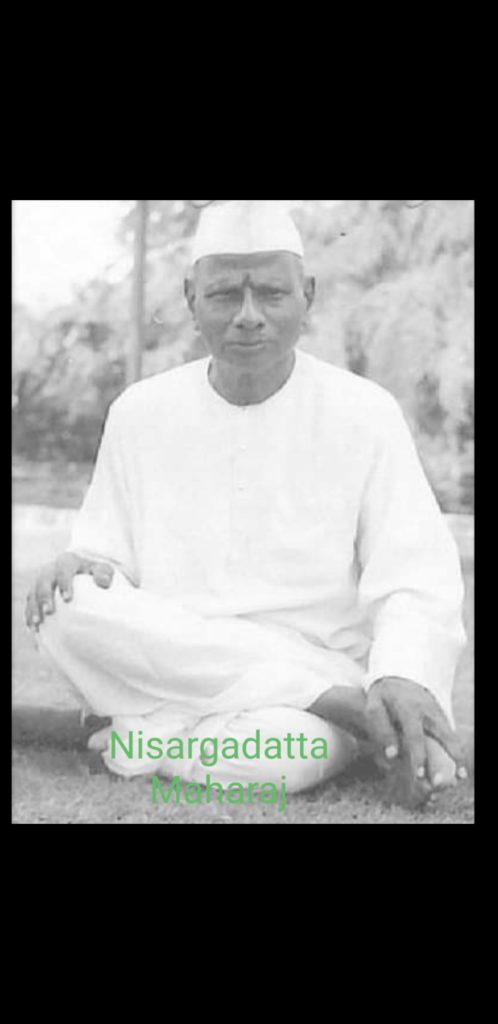
NISARGADATTA MAHARAJ

Realize once for all that neither your body nor your mind, nor even your consciousness is yourself and stand alone in your true nature beyond consciousness and unconsciousness. No effort can take you there, only the clarity of understanding. Trace your misunderstandings and abandon them , that is all .

~Sri Nisargadatta Maharaj

What is THINKING ? -JK

Comment: From my background. Thinking is the most natural process.

KRISHNAMURTI: I ask you, “Where do you live?” And your response is immediate. Isn’t it? Because where you live is very familiar to you, without a thought you reply quickly. Isn’t that so, sir? And I ask you a further complex question. There is a time lag between the reply and the challenge. In that interval one is thinking. The thinking is looking into the recesses of memory. Isn’t it?

I ask you, “What is the distance between here and Madras?” You say, “I know it, but let me look it up.” Then you say the distance is so many miles. So you have taken an interval of a minute; during that minute, the process of thinking was going on—which is looking into the memory and the memory replying. Isn’t that so, sir? Then if I ask you a still more complex question, the time interval is greater. And if I ask a question the answer to which you don’t know, you say, “I don’t know,” because you have not been able to discover the reply in your memory. However, you are waiting to check, you ask a specialist, or go back home and look into a book and tell. This is the process of your thinking, isn’t it?—waiting for an answer. And if we proceed a little further, if we ask a question of which you don’t know the answer at all, for which memory has no response, there is no waiting, there is no expectation. Then the mind says, “I really do not know, I cannot answer it.”

Now can the mind ever be in such a state when it says, “I really do not know”?—which is not a negation, which isn’t still saying, “I am waiting for an answer.” I ask you what truth is, what God is, what is, and you will reply according to your tradition. But if you push it further and if you deny the tradition because mere repetition is not discovery of God, or reality, or what you will, a mind that says “I don’t know” is entirely different from a mind which is merely searching for an answer. And isn’t it necessary that a mind should be in such a state when it says, “I really do not know”? Must it not be in that state to discover something, for something new to enter into it?

The Collected Works of J. Krishnamurti -Volume XII 1961: There Is No Thinker, Only Thought
Jiddu Krishnamurti

Mantra: “As Spirit, I …”

USE IT A-L-L THE TIME !!

Robin Starbuck That one cuts through the tedious “What realm are you in now?” “Oh golly I’m in the Third, now how do I get to the Fifth?
YOU’RE ALREADY IT !!
Edit or delete this
Like
· Reply · 35m · Edited
Robin Starbuck
Robin Starbuck As Spirit, I am everywhere now!
Edit or delete this
Like
· Reply · 28m
Robin Starbuck
Robin Starbuck As Spirit, I have every possible answer to every possible question: omniscience.
Edit or delete this
Like
· Reply · 27m
Robin Starbuck
Robin Starbuck As Spirit, I don’t even have a material body.
Edit or delete this
Like
· Reply · 26m
Robin Starbuck
Robin Starbuck As Spirit, I have no attachments whatsoever – not even wanting a solution to an ongoing (seeming) problem.
Edit or delete this
Like
· Reply · 24m
Robin Starbuck
Robin Starbuck As Spirit I am in a state of joy all the time.
Edit or delete this
Like
· Reply · 23m
Robin Starbuck
Robin Starbuck As Spirit, I see everyone correctly.
Edit or delete this
Like
· Reply · 22m
Robin Starbuck
Robin Starbuck As Spirit, I CANNOT be sick.
Edit or delete this
Like
· Reply · 22m
Robin Starbuck
Robin Starbuck As Spirit, I can never die.
Edit or delete this
Like
· Reply · 21m
Robin Starbuck
Robin Starbuck As Spirit, I dismissed all bad memories.
Edit or delete this
Like
· Reply · 20m
Robin Starbuck
Robin Starbuck As Spirit, no Thing makes me happy or sad, confident or mad.
Edit or delete this
Like
· Reply · 19m
Robin Starbuck
Robin Starbuck As Spirit, I live in my spiritual body.
Edit or delete this
Like
· Reply · 17m
Robin Starbuck
Robin Starbuck As Spirit, to the flesh I am but a beam of light.
Edit or delete this
Like
· Reply · 17m
Robin Starbuck
Robin Starbuck As Spirit, I see amazing things.
Edit or delete this
Like
· Reply · 16m
Robin Starbuck
Robin Starbuck As Spirit, I interact with all of Spirit now.
Edit or delete this
Like
· Reply · 15m
Robin Starbuck
Robin Starbuck As Spirit, I thrive in the eternal now.
Edit or delete this
Like
· Reply · 14m
Robin Starbuck
Robin Starbuck As Spirit, I see right through every claim of discord and inharmony.
Edit or delete

Advaita clarity -RS

Rupert Spira
‘Pseudo Advaita’

Q: “I understand that the natural response of awakening is to see all as Grace, but if awakening has not yet become apparent and irritation does arise, and the best you can do is pseudo advaita, is that “wrong”?”

R: I have certainly not suggested anywhere that ‘pseudo advaita’ is ‘wrong.’ However, perhaps I should clarify what I mean by ‘pseudo advaita’:

One way of defining advaita is to say that it is the experiential understanding that there are no separate entities or objects to be found anywhere in experience.

If we think and feel that we are a separate entity and think at the same time that there are no separate entities in experience, we are contradicting ourselves.

The deeper of these two thoughts is the thought that we are a separate entity (because this thought has a strong feeling attached to it) and, for this reason, I suggest that the subsequent thought that there are no entities, is simply a belief, that is is not actually true of our experience. One cannot stand as impersonal, unlimited Awareness and, at the same time, as a separate, limited entity. To take this position is disingenuous and hence the term ‘pseudo advaita.’

To say ‘I accept my suffering as an expression of Grace’ is one form of this contradiction. The ‘I’ that is suffering and the ‘I’ that is accepting is made out of the belief that ‘some-things-are-Grace-and-others-are-not.’

Such a one is the very denial of the understanding that all things are Grace, that is, it is a denial of the non-dual understanding that everything is equally an expression of Awareness. Of course, ultimately that very denial is made out of nothing but Awareness, hence, as I have often said in our correspondence, there is no real ignorance.

However, once Awareness has taken the shape of the mind which says ‘I, Awareness, am this little entity and I am therefore not everything else,’ its reality as the substance of all things, seems to be veiled. This veiling is known to us as the experience of suffering.

The position of suffering and the position in which we understand that Awareness is the substance of all things are therefore mutually exclusive. In this case non-duality is simply a belief superimposed on our dualistic feelings.

Such a position is one in which we It is think that everything is equally an expression of Awareness, whilst feeling that in fact everything is not. And then, in order to accommodate this contradiction, we add another thought which says that I completely accept my suffering as an expression of Awareness, that is, I accept my rejection of the current situation. However, suffering is synonymous with searching. If we completely accept the current situation (our suffering) why are we simultaneously rejecting it and searching for a better one?

To accept suffering is, by definition, to have no motivation to change it, but suffering is, by definition, the desire to change the current situation. So which is true, the acceptance of the current situation or the desire to change it? They cannot both be true.

This contradiction is at the heart of ‘pseudo advaita.’ Perhaps the term ‘pseudo advaita’ has a judgemental connotation to it, which is certainly not intended. It is meant to be factual. Maybe ‘intellectual advaita’ would be a better term. It is meant to indicate a situation where we have appropriated the belief in advaita and adopted it as yet one more strategy to avoid honestly facing our suffering. It is a pretence. This belief downgrades advaita from a living experiential understanding to a religion. Of course, if we are happy with this superficial understanding of life, then that is fine – there is no judgement of that. (I am not not suggesting that this is so in your case.)

Q: “On the “path” to awakening we are taught that acceptance of everything that arises is key to living with more peace……”

R: You must ask those who say such things to explain their teaching – it is certainly not what is being suggested here.

If we are suffering, we are, by definition searching, trying to change the current situation. If ‘acceptance’ is our new strategy to avoid suffering, it is just a slightly more healthy alternative to going to the fridge or whatever….It is in fact nothing to do with acceptance. Accepting something in order to get rid of it is not acceptance. It is rejection pretending to be acceptance.

Q: “If the best you can do at the time is a mental process, shouldn’t you go ahead and do it?”

R: Yes, certainly, but believing that everything is an expression of Grace whilst feeling that it is not, is not a ‘mental process.’ It is the opposite of a ‘mental process.’ It is a fixed position.

Advaita is not a fixed position or a dogma, always meeting a variety of situations or questions with the same ‘Awareness is all, Awareness is all, Awareness is all’ answer. It is true that Awareness is all, but this understanding can be refracted into as many different forms as there are situations or questions. As soon as ‘Awareness is all’ becomes a belief, it is dead. It is, as such, the opposite of advaita.

If one is suffering, I suggest that she or he has the courage and the honesty to face their suffering without any attempt to get rid of it. Just to look at it and see the facts of the situation: one, our psychological suffering involves a rejection of the current situation and two, there is a presumed separate entity at the heart of this rejection. That is the first step of the ‘mental process.’

The second is to enquire into the nature of this apparent entity. After all, if our suffering revolves around it, any understanding of suffering must involve an understanding of this apparent entity. Please note, the suggestion here is to understand suffering, not to get rid of it.

As we look towards this apparent limited entity, to our surprise we do not find it. We just find a belief and a few bodily sensations appearing in and, ultimately, made out of our own intimate Knowing Presence or Awareness. At this point the ‘mental process’ comes to an end and we simply take our stand knowingly as that which we always already are.

If the belief or feeling of separation arises again, we gently resume our investigation and exploration until we find ourselves again knowingly established as Awareness. As time goes on there is less and less investigation and more and more abidance.

Q: “Isn’t irritation an expression of Grace? How could it not be?”

R: I think I have answered this now, but at the risk of being repetitive and for the sake of thoroughness, this is tantamount to saying, “Isn’t suffering an expression of Grace?” Whilst in theory and from the absolute point of view, it is, in practise and at a relative level, it is not. If we are feeling irritated we are standing as a person, not as the absolute.

If we truly feel that our suffering is a gift of Grace (not in retrospect but while it is actually taking place) then we would be happy with our suffering; we would be glad to be suffering. In which case our suffering would be an experience of happiness, and would not therefore be experienced as suffering.

So, again, suffering is, by definition, a rejection of the current situation. Can we legitimately and honestly say, “I dislike the current situation and am therefore suffering and also enjoy it as a gift of grace?” No, these two positions are mutually exclusive. We cannot be both happy and unhappy with the current situation. It is only possible to have one feeling at a time. In such a case we are feeling one thing and thinking another.

I would suggest that such a situation is intolerable for one who is deeply interested in the nature of reality. In time, either suffering or intelligence will compel the search for a resolution.