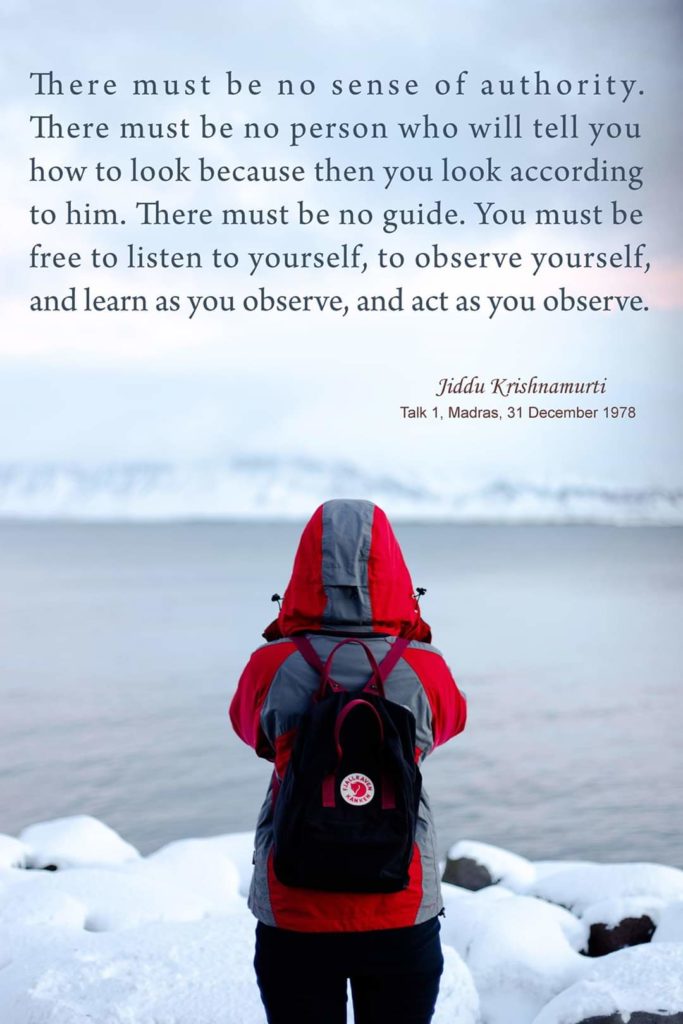
THERE IS SOMETHING SO SPECIAL, SO WONDERFUL, SO FREEING ABOUT QUITTING ALL PERSONAL SELF-PROMOTION. A SPIRITUAL ECSTASY IS FOUND WHEN TEACHERS TAKE THEIR LEAVE.

THERE IS SOMETHING SO SPECIAL, SO WONDERFUL, SO FREEING ABOUT QUITTING ALL PERSONAL SELF-PROMOTION. A SPIRITUAL ECSTASY IS FOUND WHEN TEACHERS TAKE THEIR LEAVE.

Robert Adams
Excerpt from: Satsang
‘Is Robert Unhappy?’
All of this is the self, and I am that. The self is like a gigantic screen, with images superimposed on the screen. I am aware of the consciousness and of the images. I realize the images are false, yet I see them. My feelings, my thoughts, if there are any thoughts, are observable, but my awareness is always on consciousness. What does this mean? It means I can be watching a movie or television, I can go to an opera, I can be involved in all kinds of activities, but I am not involved in anything. I am free of them. Yet to others it appears that I am involved.
This is why I am no fun to be around. People can’t understand how I can stay home by myself. They want to take me somewhere, be with me or feel sorry for me, thinking “Robert is by himself.” They say, “He should go out more often.”
But where would I go? It really makes no difference where I am. Dana used to take me to a movie every once in a while. I would make out that I was enjoying myself. After the movie she liked to discuss it. I would never know what happened. I had no idea of what was going on.
Often people tell me about this place or that, actors and actresses, or about Iraq or other things. What do I have to do with that? I realize it is a problem with others, but it’s very dim, it’s like a dream. I am totally aware of consciousness. Everything else is like a little dream, some far away someplace.
So I can be anyplace and it is the same. For example, three different people arrived at my house to take me to satsang. Somehow they were not coordinated by someone. While they were there the carpet was being cleaned and they saw people working on my carpet. The hot water radiator leaked and the carpet was flooded. But all day I was watching these goings on sitting on the chair and I was totally happy. What kind of happiness does this mean?
People can be living or dying, working or whatever. How can they be unhappy? Nobody dies. Nothing is wrong. All is well. So how can I possibly be unhappy? It is impossible.
HAVING TROUBLE WITH ENGLISH ? (for ESL students)
• Never simply assume that people will understand.
• Go back to basics.
• Don’t add flourishes from your native language.
• Write short, complete sentences. Put a period [.] at the end of every sentence.
• Never assume words and idioms from your language will be understood.
• Remember S.V.O. You need a Subject, Verb and Object in every sentence.
• Read and emulate only native English until your writing is where you need it to be.
• Encourage your native English readers to be honest with you. If they can’t understand your English, you should take responsibility.
• Avoid run-on sentences: keep them short for now.
• You have a genuine treasure to share. You can’t reach people by blaming them. Let them help you.
~ DrRobinStarbuck
Professor of English
New York University
Do please understand this a little; we have not the time to go into it in great detail because we have a vast field to cover this morning.
Knowing the cause, or the innumerable causes that breed fear, will that empty the mind of fear? Or is some other element needed?
When inquiring into what is fear, one has not only to be aware of outward reactions, but also to be aware of the unconscious. I am using that word unconscious in a very simple way, not philosophically, psychologically, or analytically. The unconscious is the hidden motives, the subtle thoughts, the secret desires, compulsions, urges, demands. Now, how does one examine or observe the unconscious? It is fairly simple to observe the conscious through its reactions of likes and dislikes, pain and pleasure, but how does one inquire into the unconscious without the help of another? Because if you have the help of another, that other may be prejudiced, limited so that what he interprets he perverts. So, how is one to look into this enormous thing called the hidden mind without interpretation—to look, to absorb, to comprehend it totally, not bit by bit? Because if you examine it fragmentarily, each examination leaves its own mark, and with that mark you examine the next fragment, thereby furthering the distortion. Therefore there is no clarity through analysis. I wonder if you are getting what I am talking about?
We can see, surely, that the discovering of the cause of fear does not free the mind from fear, and that analysis does not bring freedom from it either. There must be a total understanding, a complete uncovering of the totality of the unconscious, and how does one set about it? Do you see the problem?
The Collected Works of J. Krishnamurti -Volume XII 1961: There Is No Thinker, Only Thought
Jiddu Krishnamurti
As long as you believe you are human, you are the doer, and you are a personal I, then there’s a personal god, and that’s where prayer comes in. You can pray to your personal god, and you will be helped. Your personal god will take care of you if you surrender and submit to him or her, whatever your personal god is. But when you submit, you are giving up your ego, are you not? You’re saying I am nothing and you’re everything. This helps you. As you keep going in that direction one day you will awaken to the fact that the god you’ve been praying to is none other than your Self. For how can this god be separate from you? Where would he live? What would be his nature? You begin to understand, I am that. You find freedom in your Self. You begin to see that god is not within myself, actually, I am in God. What I call God, is consciousness. I am conscious. I am aware. I exist. I am. And there’s nothing else. You begin to see yourself as omnipresent. You are no longer limited to your body or to the personal I. You have broken through and you live in glory.
Robert Adams
When you say, “I am hurt,” what is this “I” that is hurt? You say, “You have hurt me”—by your word, by a gesture, by discourtesy, and so on and so on—what is hurt? Is it not the image that you have built about yourself? Please, do look at it. That image is one of the factors that society, education, and environment have built in you. “You” are that picture, that image, the name, the form, the characteristics, the idiosyncrasies, and so on. All that is you, the picture, the image which you are. And that image has been hurt. You have a conclusion about yourself, that you are this or that, and when that conclusion is disturbed you are hurt. So can you live without a conclusion, without a picture, without an image about yourself? As long as you have an image about yourself, you are everlastingly hurt. You may resist it, you may build a wall around yourself, but when there is a wall around yourself, when you withdraw, there is a division, and where there is a division there must be conflict—as with the Arab and the Jew, the Hindu and the Muslim, the communist and the noncommunist. Where there is a division, it is the law that there must be conflict.
So is it possible not to be hurt at all? That is, to have an innocent mind, a mind that is incapable of being hurt. It is very important to find out if one can live that in daily life. Not go off to some monastery or some community where you all agree together, becoming mushy and sentimental, but actually in daily life to find out if you can live without an image and, therefore, never be hurt, which means never to have conflict, never to have psychological division. We are going to find out. We are going to examine whether it is possible to live that way.
Total Freedom:
The Essential Krishnamurti
Jiddu Krishnamurti
“Are you worried? Do you have many ‘what if’ thoughts? You are identified with your mind, which is projecting itself into an imaginary future situation and creating fear. There is no way that you can cope with such a situation, because it doesn’t exist. It’s a mental phantom.”
~ Eckhart Tolle
“Every one of us is a unique spark of the divine, a light unto this world. And no true light should remain hidden under a cloak of fear and denial. Allow your true being to step out in love and courage, and embrace the full measure of your life. All the rest happens in its own good time.”
~ Adyashanti
“The egoic mind is the cause of suffering. Nothing more. Suffering only happens in response to a thought. We suffer because we think something about what is happening, what happened, or what might happen. We create a story about what is, what was, or what will be; then we suffer over it. We particularly suffer over fears, which are negative ideas about the future, although any idea can cause suffering if it is believed.”
~ Gina Lake
“Between the banks of pain and pleasure the river of life flows. It is only when the mind refuses to flow with life, and gets stuck at the banks, that it becomes a problem. By flowing with life I mean acceptance — letting come what comes and go what goes. Desire not, fear not, observe the actual, as and when it happens, for you are not what happens, you are to whom it happens.”
~ Nisargadatta
“When God sends suffering, the spiritually weak react by fleeing from God; the lovers of God react by moving closer to Him. In battle all fear death, but the cowards choose to retreat while the brave charge toward the enemy.”
~ Rumi
Whatever demand is legitimately made upon us is not made upon us: it is made upon the Christ of us. If some demand is made upon us that is illegitimate, we should take the same attitude, because if it is an illegitimate demand, it will never have to be met. The Christ will find a way to dissolve even that demand. That is important.
We never have to be afraid of an injustice once we have taken our stand as spiritual beings. If some persons seem to demand more of us than they have a right to demand, we realize that if the Christ of us can supply it, we are perfectly willing. If it is not a legitimate demand, the Christ will dissolve that demand made upon us. Otherwise It will meet it, once we have removed that personal sense of “I” that is self-righteous, has a need, or requirement.
Joel S. Goldsmith
Showing Forth The Presence
of God
Chapter 6, Section: “We
Let the Christ of our Being
Fulfill Every Demand”
The life story of the most famous person who has ever lived is, in fact, filled with a mysterious gaping hole. From the age of 13 to 29 there is no Biblical, Western, or Middle Eastern record of Jesus‘s whereabouts or activities in Palestine. Known as “The Lost Years,” this gaping hole remained a mystery until one explorer’s remarkable discovery in1887.
In the late 19th century a Russian doctor named Nicolas Notovitch traveled extensively throughout India, Tibet, and Afghanistan. He chronicled his experiences and discoveries in his 1894 book The Unknown Life of Christ. At one point during his voyage, Notovitch broke his leg in 1887 and recuperated at the Tibetan Buddhist Monastery of Hemis in the city of Leh, at the very top of India. It was here where monks showed Notovitch two large yellowed volumes of a document written in Tibetan, entitled The Life of Saint Issa. During his time at the monastery, Notovitch translated the document which tells the true story of a child named Jesus (i.e. Issa = “son of God”) born in the first century to a poor family in Israel. Jesus was referred to as “the son of God” by the Vedic scholars who tutored him in the sacred Buddhist texts from the age of 13 to 29. Notovitch translated 200 of the 224 verses from the document.
During his time at the monastery in1887, one lama explained to Notovitch the full scope and extreme level of enlightenment that Jesus had reached. “Issa [Jesus] is a great prophet, one of the first after the twenty-two Buddhas,” the lama tells Notovitch. “He is greater than any one of all the Dalai Lamas, for he constitutes part of the spirituality of our Lord. It is he who has enlightened you, who has brought back within the pale of religion the souls of the frivolous, and who has allowed each human being to distinguish between good and evil. His name and his acts are recorded in or sacred writings. And in reading of his wondrous existence, passed in the midst of an erring and wayward people, we weep at the horrible sin of the pagans who, after having tortured him, put him to death.”
The discovery of Jesus’s time in India lines up perfectly with The Lost Years of Jesus, as well as with the degree of significance of his birth in the Middle East. When a great Buddhist, or Holy Man (i.e. Lama), dies, wise men consult the stars and other omens and set off often on extraordinarily long journeys to find the infant who is the reincarnation of the Lama. When the child is old enough he is taken away from his parents and educated in the Buddhist faith. Experts speculate that this is the foundational origin of the story of the Three Wise Men, and it is now believed Jesus was taken to India at 13 and taught as a Buddhist. At the time, Buddhism was already a 500-year-old religion and Christianity, of course, had not even begun.
Hurt and flattery are the same, aren’t they? Both are different forms of hurts. You are flattered, and you like it, and the flatterer becomes your friend. So that also is another form of encouraging the image. The one you want, the other you don’t want. We are now dealing only with what we don’t want, which is not to be hurt; but we want the other, which is pleasurable, which is comforting, pleasing to the images that we have. So both are the same. Now how am I, how is a human being, to be free of hurt? So we have to go into the question of what it is to be attentive.
What does it mean to attend? If you know what it means to attend, it may solve the problem. Have you ever given total attention to anything? Complete attention in which there is no center from which you attend? When there is a center from which you attend then there is a division. Let’s put it differently. You know what it is to be aware. One is aware of the trees under which we are sitting, aware of the branches, the color of the branches and their thickness, of the leaves, the shadows, aware of all the nature, the beauty of it. [The Ojai talks took place in the open in a grove of oaks.] Then you are also aware of sitting on the ground, the color of the carpet, the microphone. And can you be aware of all this, the microphone, the carpet, the earth, the color of the leaves, and so on, the blue shirt, be aware of all that without any choice? To look at it without any choice, judgment, just to look.
Total Freedom: The Essential Krishnamurti
Krishnamurti