PRINCESS OF KASHI!!! IT IS US!!!
The ultimate secret of OM -SS
Some pebbles -rjs
MAKING THOSE TIMELY CONNECTIONS
When we think in terms of events developing as time goes by, we are subscribing to a 3D construct of ourselves, like the pilot who gives the control tower her location in terms of distance – not only north and east – of a given point, but also advises them of her altitude. This dynamic, according to Newton, and most Christians I know, moves forward in one direction and in one-dimensional time. We need a Big Apple to fall on our collective head to accept the fact that we live in – at least – a four-dimensional realm, borne out by the special theory of relativity in which things do not move forward but remain static and everything that we, in all our prayers, hope for, already exists. rjs
▪︎▪︎▪︎▪︎▪︎
Whenever you’re in any form of disquiet, i.e., fear, doubt, anxiety, loss, suffering,
it means ur not in your true
CONSCIOUSNESS
▪︎▪︎▪︎▪︎▪︎
We have no right to sickness, poverty, suffering, discord…
Unless of course we invite world mind in, give him a cup of coffee…
▪︎▪︎▪︎▪︎▪︎
If you are looking for me
Me doesn’t live anymore.
I am set
Entirely Free.
▪︎▪︎▪︎▪︎▪︎
That which never was
Has died
And “I” is f-r-e-e
▪︎▪︎▪︎▪︎▪︎
Swami Sarvapriyananda on Conscious Experience -SS
THERE IS NO PROBLEM OF CONSCIOUSNESS .
The eye of the eye, the ear of the ear, the speech of the speech: CONSCIOUSNESS IS NOT PART OF THE BODY, NOT PRODUCED BY THE BODY.
Man descending into a field in a hot air balloon asks a farmer on the ground “Where am I?”
“You are in a balloon.”
“Sir, are you a mathematician?”
“Yes, how did you know?”
“Your answer was absolutely correct and absolutely useless.” LOL
Anyone searching for CONSCIOUSNESS will never find it because he’s the one who’s looking. He is it.
The very fact of your seeing (experiencing-RS) means you have eyes, consciousness. You’re not being vague paradoxical or tricky. You’re using language in the best way that you possibly can. By YOUR LIGHT your entire body system is lit up and shining. In Vedanta that is exactly what we call God.
The grip of ego: Spirit not the ego -ET
The challenges of life- do we convert them into unhappiness? Or do we go with them and do what must be done? All these things are wonderful that they happened to you because they brought about your awakening! Especially the bad things they pushed you into awakening.
Reality is. No expression, thought, feeling. -NM
REALITY
Neither action, nor feeling, nor thought express reality.
There is no such thing as an expression of reality.
You are introducing a duality where there is none. Only reality is, there is nothing else.
………………………………..
Reality is neither subjective nor objective, neither mind nor matter, neither time nor space.
You cannot speak about it; you can only
lose your self in it. When you deny reality to anything, you come to a residue which cannot be denied.
- Nisarga Yoga: The Self Knowledge Teaching of Nisargadatta Maharaj
You are the world -JK
You are the world, the world is you. You are the society, the culture in which you have been born and brought up. That culture, that society is the result of your efforts, of your greed, your brutality, your violence. So you are the world, you are the community, you are the society, the culture. Do please realize that in this country where there is so much corruption, disorder, callousness, brutality, total indifference, you are responsible, each one, because you are India. You have brought about, put together through time the social structure with its divisions, you have put together the religions, the beliefs, the innumerable gods, and you have built this society. So the world is you and you are the world. Do realize this deeply, feel it with your heart, not with your petty little, cunning, insensitive mind, because that is the fact, and that fact is not a theory, is not an idea. The explanation is not the explained, the description is not what is described.
To bring about a vast, radical revolution – and that radical revolution is necessary not merely outwardly but in oneself unless you change, unless you cease completely to be a Hindu or a Buddhist or a Christian a Communist, merely bringing about a superficial reformation – altering a few patterns here and there, is not going to bring about peace to man at all. So it is your responsibility: it is the way you lead your life, the way you think, your activity, your daily corrupting ways, unless there is a psychological, inward revolution in that, there is no possibility of really deep, profound, social changes.
Krishnamurti in India, 1970-1971
Authentic Reports of Talks
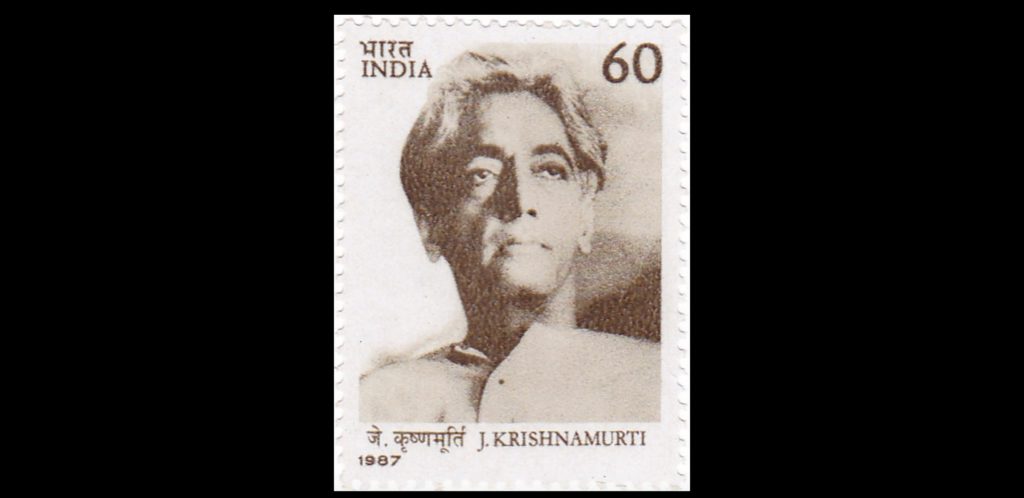
Jiddu Krishnamurti
Jiddu Krishnamurti was an Indian philosopher, speaker and writer. In his early life he was groomed to be the new World Teacher but later rejected this mantle and withdrew from the Theosophy organization behind it. His interests included psychological revolution, the nature of mind, meditation, inquiry, human relationships, and bringing about radical change in society. He stressed the need for a revolution in the psyche of every human being and emphasised that such revolution cannot be brought about by any external entity, be it religious, political, or social.
The analyzer is the analyzed/ conditioned VIDEO -JK
If you try to analyze the conditioning you are merely analyzing the conditioner and going round and round in a vicious circle. If psychiatrists allowed themselves to recognize this they would lose their jobs their practice, their victims their patients!
▪︎▪︎▪︎▪︎▪︎▪︎▪︎▪︎▪︎▪︎
You are not different from your conditioning.- J. Krishnamurti.
Extracts from the first discussions in Saanen1978.
Born human being is opportunity to discover -RAdams
It is a rare privilege to be born as a human being, even though it is an illusory birth. But to be born as a human being is the only way you can find yourself. An animal, a tree, a mineral cannot do this. You have been given the rare opportunity of birth so that you may find self-realization, and unfold into your true nature. Do not use your time for anything else. This is the purpose of being in this birth, to become absolutely free and liberated.
Robert Adams
Love is not an objective experience bound by time -FL
Love of objects is not permanent, but love itself is permanent.