Very, very committed East & West

Fixing the mind firmly on Brahman [God],
the point of concentration,
restraining the sense organs in their respective centers,
holding the body steady and giving up all thoughts for its maintenance,
attaining identity with Brahman [God] and being One with it,
continuously drink the bliss of Brahman in your own Self.
Of what use are other things?
They are entirely false, empty illusions.

— Adi Shankaracharya. Vivekachudamani

Own a Canadian! Lol

Dear Dr. Laura [Schlesinger, radio talk show host]:
Thank you for doing so much to educate people regarding God’s Law. I have learned a great deal from your show, and try to share that knowledge with as many people as I can. … I do need some advice from you, however, regarding some other elements of God’s Laws and how to follow them. Leviticus 25: 44 states that I may possess slaves, both male and female, provided they are from neighboring nations. A friend of mine claims that this applies to Mexicans, but not Canadians. Can you clarify? Why can’t I own Canadians? I would like to sell my daughter into slavery, as sanctioned in Exodus 21: 7. In this day and age, what do you think would be a fair price for her? I know that I am allowed no contact with a woman while she is in her period of Menstrual “uncleanliness”—Lev. 15: 19–24. The problem is, how do I tell? I have tried asking, but most women take offense. When I burn a bull on the altar as a sacrifice, I know it creates a pleasing odor for the Lord—Lev. 1: 9. The problem is my neighbors. They claim the odor is not pleasing to them. Should I smite them? I have a neighbor who insists on working on the Sabbath. Exodus 35: 2 clearly states he should be put to death. Am I morally obligated to kill him myself, or should I ask the police to do it? A friend of mine feels that even though eating shellfish is an abomination, Lev. 11: 10, it is a lesser abomination than homosexuality. I don’t agree. Can you settle this? Are there degrees of abomination? Lev. 21: 20 states that I may not approach the altar of God if I have a defect in my sight. I have to admit that I wear reading glasses. Does my vision have to be 20/ 20, or is there some wiggle-room here? Most of my male friends get their hair trimmed, including the hair around their temples, even though this is expressly forbidden by Lev. 19: 27. How should they die? I know from Lev. 11: 6–8 that touching the skin of a dead pig makes me unclean, but may I still play football if I wear gloves? My uncle has a farm. He violates Lev. 19: 19 by planting two different crops in the same field, as does his wife by wearing garments made of two different kinds of thread (cotton/ polyester blend). He also tends to curse and blaspheme a lot. Is it really necessary that we go to all the trouble of getting the whole town together to stone them? Lev. 24: 10–16. Couldn’t we just burn them to death at a private family affair, like we do with people who sleep with their in-laws? (Lev. 20: 14) I know you have studied these things extensively and thus enjoy considerable expertise in such matters, so I’m confident you can help. Thank you again for reminding us that God’s word is eternal and unchanging. Your devoted disciple and adoring fan. AJC
P.S. (It would be a damn shame if we couldn’t own a Canadian.)

The mind will fade away of its own accord -RM

“People often ask how the mind is controlled. I say to them, ‘Show me the mind and then you will know what to do.’ The fact is that the mind is only a bundle of thoughts. How can you extinguish it by the thought of doing so or by a desire? Your thoughts and desires are part and parcel of the mind.

The mind is simply fattened by new thoughts rising up. Therefore it is foolish to attempt to kill the mind by means of the mind. The only way of doing it is to find its source and hold on to it. The mind will then fade away of its own accord.”

~ Ramana Maharshi (20th century Indian Advaita mystic)

Transcend ego, avoid fame, leave everything alone -RAdams

“A [truly enlightened Sage] avoids name and fame like the plague. If a Sage has transcended the ego why would he or she need name or fame? If a Sage claims to be enlightened why would that being want to be known? To have a following, to write books, to advertise, to go into magazines, television. Can you imagine a real Master doing something like that? For what purpose?

If you inquire of a person like this they would say, ‘Well I’m here to help people.’ Bullshit! The only way to help other people is to become self-realized and leave everything alone. Why a self-realized person is all-pervading, omnipresent and automatically people find peace by the person being self-realized.

You don’t even have to be in the proximity of a saint, a Sage, a real Master. There is no reason [for] being in close proximity to a person like that. That being is all-pervading, everywhere present. Such a one has found total peace within the Self. They’re not looking for anything. They’re not looking for students to impress, followers to follow them. They avoid this like the plague. …

A real Sage feels at home wherever he or she lives wherever they go. A Sage can be happy in a cave or in a mansion, makes no difference. It makes a difference to the onlookers. They always see something wrong and talk about it. But a true Sage is total freedom, totally happy within himself.”

~ Robert Adams (20th century American Advaita mystic)

Parabrahman

Para Brahman

Highest Brahman


Para Brahman (Sanskrit:परब्रह्मन्) (IASTPara Brahman) is the “Highest Brahman” that which is beyond all descriptions and conceptualisations. It is described in Hindu texts as the formless (in the sense that it is devoid of Maya) spirit (soul) that eternally pervades everything, everywhere in the universe and whatever is beyond.

Hindus conceptualize the Para Brahman in diverse ways. In the Advaita Vedanta tradition, Nirguna Brahman (Brahman without attributes) is Para Brahman. In Dvaita and Vishistadvaita Vedanta traditions, Saguna Brahman (Brahman with qualities) is Para Brahman. In VaishnavismShaivism and ShaktismVishnuShiva and Shakti respectively are Para Brahman. Mahaganapati is considered as Para Brahman by the Ganapatya sect.

Etymology

Para is a Sanskrit word that means “higher” in some contexts, and “highest or supreme” in others.

Brahman connotes the Highest Universal Principle in Hinduism, the Ultimate Reality in the universe. In major schools of Hindu philosophy it is the material, efficient, formal and final cause of all that exists. Brahman is a key concept found in Vedas, and extensively discussed in the early Upanishads.

Para Brahman means the “Highest Brahman”. It is found in early Advaita Vedanta literature.

Advaita Vedanta – Nirguna Brahman

Nirguna Brahman (Devanagari निर्गुण ब्रह्मन्, Nirguṇa Brahman), Brahman without form or qualities, is Para Brahman, the highest Brahman. According to Adi Shankara, Nirguna Brahman is Para Brahman, and is a state of complete knowledge of self as being identical with the transcendental Brahman, a state of mental-spiritual enlightenment (Jnana yoga). It contrasts with Saguna Brahman which is a state of loving awareness (Bhakti yoga). Advaita Vedanta non-dualistically holds that Brahman is divine, the Divine is Brahman, and this is identical to that which is Atman (one’s soul, innermost self) and nirguna (attribute-less), infinite, love, truth, knowledge, “being-consciousness-bliss”.

According to Eliot Deutsch, Nirguna Brahman is a “state of being” in which all dualistic distinctions between one’s own soul and Brahman are obliterated and are overcome. In contrast, Saguna Brahman is where the distinctions are harmonized after duality between one’s own soul and Brahman has been accepted.

Advaita describes the features of a nondualistic experience, in which a subjective experience also becomes an “object” of knowledge and a phenomenal reality. The Absolute Truth is both subject and object, so there is no qualitative difference:

  • “Learned transcendentalists who know the Absolute Truth call this nondual substance Brahman, Paramātmā or Bhagavān.” (Bhagavata Purana 1.2.11)
  • “Whoever realizes the Supreme Brahma attains to supreme felicity. That Supreme Brahma is Eternal Truth (satyam), Omniscient (jnanam), Infinite (anantam).” (Taittiriya Upanishad 2.1.1)

The Upanishads state that the Supreme Brahma is Eternal, Conscious, and Blissful sat-chit-ânanda. The realisation of this truth is the same as being this truth:

  • “The One is Bliss. Whoever perceives the Blissful One, the reservoir of pleasure, becomes blissful forever.” (Taittiriya Upanishad 2.7.1-2)
  • “Verily know the Supreme One to be Bliss.” (Brihadaranyaka Upanishad 2.9.28)

Vaishnavism

In VaishnavismVishnu or Krishna (among other incarnations of Vishnu) is considered as Para Brahman. Vishnu in his universal form is considered to be the supreme. According to Bhagavat Purana, when Arjuna asked the true reality about Krishna, he revealed his Parabramhan form showing that he is the supreme form of souls, demons, deities and qualities, namely, Sattva, Rajas and Tamas.

Shaivism

In ShaivismShiva is Para Brahman. Parashiva, the supreme form of Lord Shiva, is considered as Para Brahman. According to mythology, Parashiva is the single incarnation of all souls and deities. He is also depicted as the only Adipurusha or Mahadeva.

Kashmir Shaivism

Main article: Kashmir Shaivism

In Kashmir Shaivism, Svachhanda Bhairava is considered as the supreme form of Lord Shiva. Kashmir Shaivism consider Svachhanda Bhairava as Para Brahman. Kashmir Shaivism holds turiya the fourth state of consciousness as Brahman. It is neither wakefulness, dreaming, nor deep sleep. In reality, it exists in the junction between any of these three states, i.e. between waking and dreaming, between dreaming and deep sleep, and between deep sleep and waking. . In Kashmir Shaivism there exists a fifth state of consciousness called Turiyatita – the state beyond Turiya which represents Parabrahman. Turiyatita, also called the void or shunya is the state where one attains liberation otherwise known as jivanmukti or moksha.

Shaktism

In ShaktismMahakali Devi or Tripura Sundari the supreme form of Devi Adi parashakti, is considered to be the Para Brahman or energy of the Brahman, ultimate reality, inseparably. According to Devi Suktam and Sri Suktam in Rigveda she is the womb of all creation. Thus Mahakali is epithets is Brahmamayi, meaning “She Whose Essence is Brahman”. Parvati as Lalita Tripura Sundari Her eternal abode is called Manidvipa.

Sikhism

Parbrahm is regarded as the supreme reality in Sikhism. It is also known as “Akaal purakh” (immortal being) and is also known by mantra “Waheguru” .

Sikh scripture and the last sikh guru, Sri Guru Granth Sahib refers to Parbrahm with a variety of adjectives and nouns , such as Nirankar, Niranjan, Bhagat Vachhal , Kirpal , Dayal, Deen Dayal , Madho, Raam, Hari, Rahim, Karim, Rehman, Parvardigar, Sahib, Malik , etc…..

See also
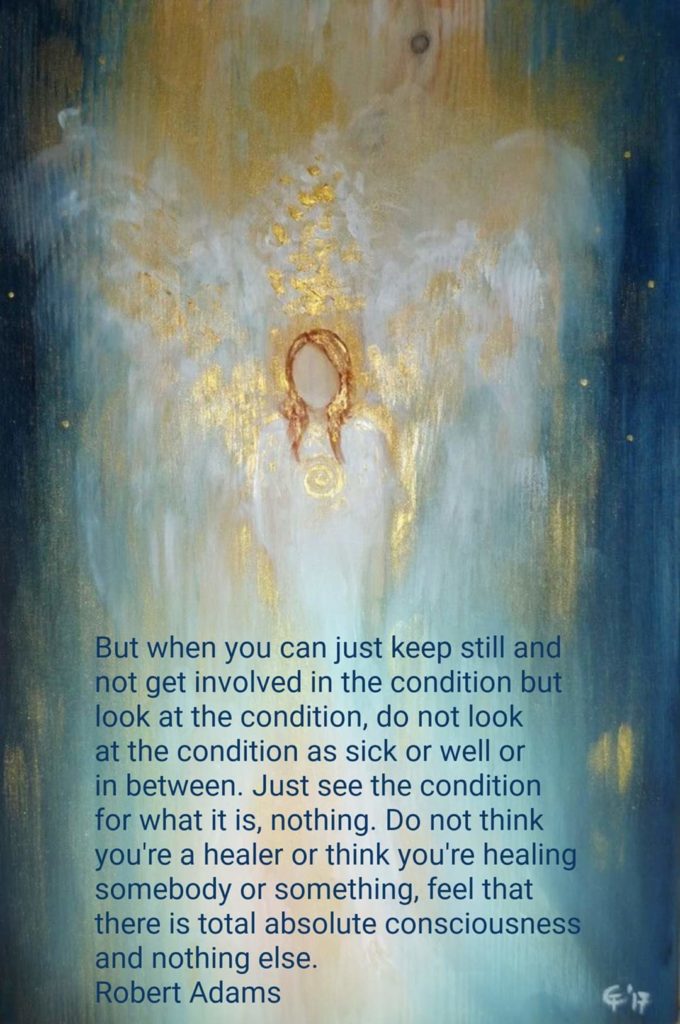

Why not accept blissful reality?

“All I can really do for you is to confess my own reality, and my own reality is also your reality. I am sat-chit-ananda [existence-consciousness-bliss]. I am Parabrahman. I am ultimate oneness. I am divine love, pure consciousness. I am that I am, emptiness, nirvana. There is nothing else. All of your worries, all of your fears, have no foundation. There is only the one and you are that. Why will you not accept it?”

~ Robert Adams (20th century American Advaita mystic)

How to become detached -RAdams

How do you become detached? By simply observing what’s going on around you and not attaching yourself to it. By being awake to your reality. Understanding yourself that you are not the doer.

You have to let go mentally of all conditioning, of all objectivity. And you must still your mind. Make your mind placid, like a motionless lake. Then reality comes of its own accord. Happiness comes of its own accord. Peace comes of it own accord. Love comes of its own accord. Freedom comes of its own accord. These things are synonymous. They happen without you ever thinking about them. But first you must get rid of the notion, that I am the body, or mind, or the doer and then everything will happen by itself.

~Robert Adams

You’ll reincarnate again and again until reattached -RAdams

You have attached yourself to sickness, to health, to good, to bad, to happiness, to unhappiness, these are all concepts. You’ve attached yourself to person, place or thing. You have forgotten that this is a dream. You believe it’s real and because you believe it’s real you suffer accordingly. When you leave your body you will have to come back again and again and again, all part of the dream, until you become detached.

♾☮ Robert Adams