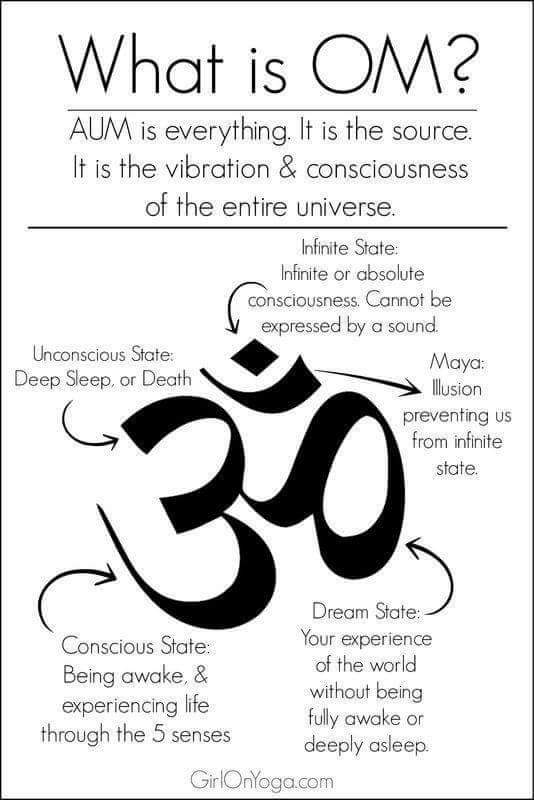
OM = AUM, everything, source, vibration, consciousness of whole universe, infinite, absolute, opposite of Maya(illusion, world), …
Here is some explanation for you and maybe other members can add, especially from Arabic meaning. Online ‘The Om symbol is a combination of curves, a crescent and a dot. The meaning of the Om symbol, while purely looking at its visual form, comes from the states of consciousness that Aum represents. The letter ‘A’ represents the waking state, ‘U’ represents the dream state and ‘M’ is the unconscious state, or state of deep sleep.
In the symbol, the waking state is represented by the bottom curve, the dream state is the middle curve and the state of deep sleep is represented with the upper curve. The crescent shape above the curves denotes Maya, or Illusion, which is the obstacle that sits in the way of reaching the highest state of bliss. The dot at the top of the symbol represents the absolute state, which is the fourth state of absolute peace and bliss, that is only one state actually. ‘ Yod from Hebrew would definitely be similar to the dot, which is the ‘I’ name of God as also explained by Rupert Spira, and crescent moon has definite meaning in Hebrew and all esoteric traditions and relates to evolution of consciousness. Hope I was able to help a bit. Anna Bharati Wysocka
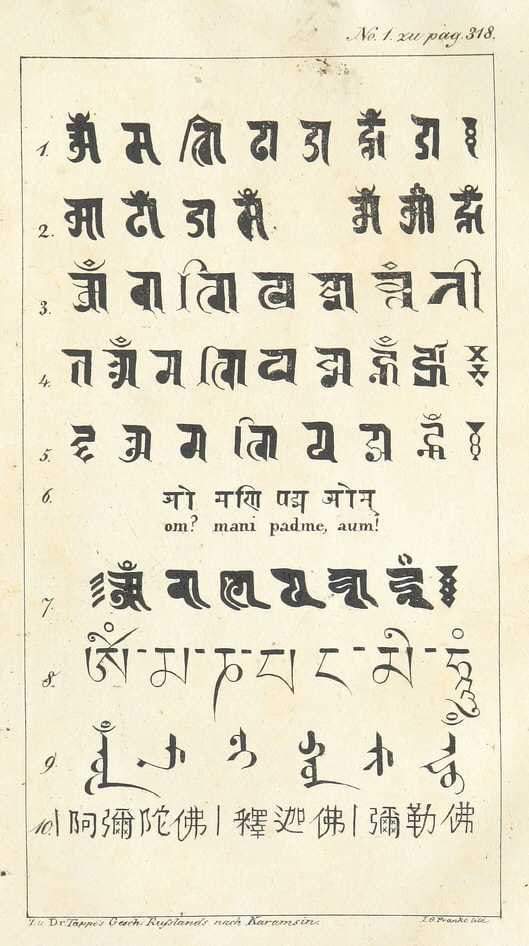
Anna you covered the most commen in your comment. The symbol is the first letter in Sanskrit = A.(A is build of 3 lines or I’s.(I-I) The part 3 from the symbol is the number 3 and means 3. Its the same as the trinity in Christianity. Father, son and holy spirit. Brahma, Vishnu and Shiva. All there is… First dot were all is coming from. Half circle can be the circle of ring pass not the second.( hidden part) And then the 3. Creation… Its first sound from the new bourn when it comes out from the mother screaming aaa, auuu and ending aummm. First is birth, second withholding (continuing)and third destruction. Out breath, pause and in breath then a knew pause that compleat the round. (fourth). The tail on the 3 that becomes a circle is not always a circle but is included as a tail in the number 3 in Sanskrit. Often its just a tail(snake, continuous. But as circle a conclusion of all. Included in the dot is the the 3 from previous round as its always this 3 that are and it becomes the 3 again… a little on the subject!
Robin Starbuck I think you can see the link the tail.
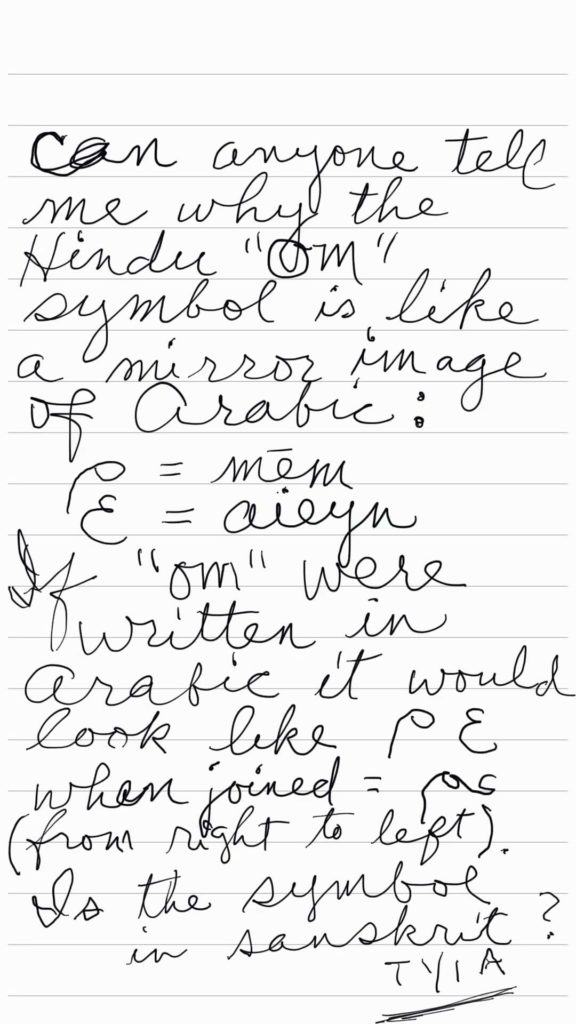
Arabic is one of the oldest writhen language.
All languages come as symbols from sound.
Hinduism and Islam are living close and Islam and Christianity are bourn from the same.
Before it become language it was pictures symbols and that become letters and words.
9 is a deep symbol in it self as number nine then as snake, boat, link, spiral, broken circle and circle, nr of initiations to fulfilment, 3×3….
Arabs used it alot as boat(link),snake in there old language and in the Om symbol we can also se it as a link to the new dot a new birth a new round…or just as all there is and will always be in continuum…
So when it become letters and words all languages are conected by symbols,words, sounds that they got from each other and mixed in to there own.
Advaita vedanta – path of exclusion, inwards facing path, direct path to realization of our true Self Kashmir Tantric approach – path of inclusion, outwards facing path, identification with All Rupert Spira suggests and teaches both, as they both have strengths and both have weaknesses, and both lead to same ‘place’ of realization if understood and practiced correctly. Anna Bharati Wysocka
“[If you stop thinking] you will function much better than you do now, for you will always be taken care of. The universe loves you. It will always supply you with your needs. Forget about other people, what they do, what they don’t do. Do not listen to malicious gossip.
Be yourself. Understand who you really are. You are the absolute reality, unconditioned consciousness. Work from that standpoint. Do not work from your problems. Do not get lost in meaningless gossip. Understand your true reality. Be yourself.”
~ Robert Adams (20th century American Advaita mystic)
Bliss is a word again that cannot be described. It makes happiness feel like nothing. It is not of this world. You do not even experience it. You simply enjoy it. When you are in bliss it is then that you lose yourself completely. The personal-I, the personal self at that time no longer exists. It has been dissolved forever. It is a state that you cannot return from. It is not something that you feel when you are meditating then you get back to the personal self. There is no personal self. You are finished with your ego, with your personal self and with the I-thought. You have become nothing. You have melted. You have been destroyed. Yet you are alive.
You feel that you are alive and you do not know how you live. For so-called life that you have been experiencing previously no longer exists for you. You have become the Self and you can laugh. For you realize that you have always been the Self. There never was a time that you were not the Self. You are free, totally free. The world is no longer the world that you once knew. You continue to see the images but the images are like chalk writings on the blackboard. And you are the chalkboard. You’re free, totally absolutely free.
If you look into the life of every sage, they didn’t come here to make you happy. They came here to take away your so-called human happiness. They came to show you that human happiness is transitory. It is not permanent. They came to upset you, to upset your lifestyle, not to bring you happiness.
We still have a tendency to believe that when we get into a spiritual teaching, all of our humanhood will improve drastically. If we are sick we’ll be healed, if we are poor we’ll be rich, if we have mental anguish, we’ll have joy and happiness. But that’s not a spiritual teaching. Your feelings and your life so-called and your body have nothing to do with spirituality. You gotta understand this once and for all.
True spirituality goes beyond the relative world. It has absolutely nothing to do with the human condition. Yet you’ve heard me say many times that your humanhood also improves, so it sounds like a contradiction. But what I meant was this: when you make the transcendence, when you awaken to your true self, you have no idea what’s going on with the body. You are in a different dimension so to speak.
If you want to go all the way, throw all away. And right there, there is a joy, a freedom and lightness. Strip everything back to nothing. Throw your attachments, your desires, your needs and immediately you are in a state of total freshness. Total wholeness. Every human being should do this once in a while. The serious seeker develops this unsparing attitude to free their minds from the cholesterol of egoic identity.
Be in that emptiness and you see that emptiness is completeness. And the more you do it, the more you enjoy the effortlessness of it all. Now, you ignore the voice of the interpreter, the journalist, the accountant or the mathematician and in a short while, you won’t want him back. If you want to go all the way, throw all away
(Advaita – Not Two-Non Duality), (Vedanta- End of Vedas ‘Upanishad’) is basically and understanding by which ignorance is removed with the knowledge. Ignorance here implies to a belief that “I am a body/mind”. Advaita has two stages when it’s first understood. In the first stage, one separate’s itself from what is not real, such as I am not my body, mind and intellect and reaches at a point of a Witness Self, which in itself is a great achievement.
But Advaita which stands for non duality will argue, what is a point in being a witness only, as it would be also argued and seen by many as duality. “Witness Self and the Other”.
Advaita in a second stage, it then merges back as ONE (I Am THAT I Am) with the intellect, mind, body and the world and recognizes all are only an appearances, forms, names and transactions (Maya), and seeing itself as (ONE) Brahman as an Ultimate Reality, A Non Dual Self…
here are some more quotes from physicists and scientists take on this
“I regard consciousness as fundamental. I regard matter as derivative from consciousness. We cannot get behind consciousness.
Everything that we talk about, everything that we regard as existing, postulates consciousness.”
– Max Planck, German theoretical physicist
“There is no kind of framework within which we can find consciousness in the plural; this is simply something we construct because of the temporal plurality of individuals, but it is a false construction…
The only solution to this conflict insofar as any is available to us at all lies in the ancient wisdom of the Upanishad… Vedanta teaches that consciousness is singular,
all happenings are played out in one universal consciousness and there is no multiplicity of selves.”
Erwin Schrodinger, Austrian physicist
“The entire universe must, on a very accurate level, be regarded as a single indivisible unit in which separate parts appear as idealisations permissible only on a classical level of accuracy of description.
This means that the view of the world being analogous to a huge machine, the predominant view from the sixteenth to nineteenth centuries, is now shown to be only approximately correct. The underlying structure of matter, however, is not mechanical.
This means that the term “quantum mechanics” is very much a misnomer. It should, perhaps, be called “quantum nonmechanics”
. – David Bohm (theoretical physicist), Quantum Theory
“Consciousness is much more of the implicate order than is matter . . . Yet at a deeper level [matter and consciousness] are actually inseparable and interwoven ,
just as in the computer game the player and the screen are united by participation.”
David Bohm, American theoretical physicist
“According to Bohm, the ground of the cosmos is not elementary particles but pure process, a flowing movement of the whole.
Within this implicate order, Bohm believed, one could resolve the Cartesian split between mind and matter, or between brain and consciousness.”
F. David Peat, researcher
“As a man who has devoted his whole life to the most clearheaded science, to the study of matter, I can tell you as a result of my research about the atoms this much:
There is no matter as such!
All matter originates and exists only by virtue of a force which brings the particles of an atom to vibration and holds this most minute solar system of the atom together
… We must assume behind this force the existence of a conscious and intelligent Mind.
This Mind is the matrix of all matter.” – Max Planck, German theoretical physicist
“The stream of knowledge is heading towards a non-mechanical reality; the Universe begins to look more like a great thought than like a great machine.
Mind no longer appears to be an accidental intruder into the realm of matter… we ought rather hail it as the creator and governor of the realm of matter”
– Sir James Jean, English physicist
“It was not possible to formulate the laws (of quantum theory) in a fully consistent way without reference to consciousness”
“It will remain remarkable, in whatever way our future concepts may develop, that the very study of the external world led to the scientific conclusion that the content of the consciousness is the ultimate universal reality”
– Eugene Wigner
“The common division of the world into subject and object, inner world and outer world, body and soul is no longer adequate.” – Werner Heisenberg, German theoretical physicist
“The doctrine that the world is made up of objects whose existence is independent of human consciousness turns out to be in conflict with quantum mechanics and with facts established by experiment.”
Bernard d’Espagnat, French theoretical physicist
“Consciousness cannot be accounted for in physical terms.
For consciousness is absolutely fundamental. It cannot be accounted for in terms of anything else.”
Erwin Schroedinger
“What quantum mechanics tells us, I believe, is surprising to say the least. It tells us that the basic components of objects – the particles, electrons, quarks etc.
– cannot be thought of as “self-existent”. The reality that they, and hence all objects, are components of is merely “empirical reality”.
This reality is something that, while not a purely mind-made construct as radical idealism would have it, can be but the picture our mind forces us to form of … Of what ?
The only answer I am able to provide is that underlying this empirical reality is a mysterious, non-conceptualisable “ultimate reality”, not embedded in space and (presumably) not in time either.”
Bernard d’Espagnat
“…the contemporary understanding of material is very different now from the way it used to be. If we consider what matter really is, we now understand it as much more of a mathematical thing…
But I think that matter itself is now much more of a mental substance…”
Roger Penrose, English physicist
“[Is mind] primary or an accidental consequence of something else?
The prevailing view among biologists seems to be that the mind arose accidentally out of molecules of DNA or something. I find that very unlikely. It seems more reasonable to think that mind was a primary part of nature from the beginning and we are simply manifestations of it at the present stage of history.
It’s not so much that mind has a life of its own but that mind is inherent in the way the universe is built.”
Freeman Dyson, American theoretical physicist
“The notion of a separate organism (a body) is clearly an abstraction, as is also its boundary. Underlying all this is unbroken wholeness even though our civilization has developed in such a way as to strongly emphasize the separation into parts.”
David Bohm, The Undivided Universe: An Ontological Interpretation of Quantum Theory
Ashtavakra said: 18.1 Praise That, which is Bliss itself, which is by nature stillness and light, and which by Its knowing reveals the world as a dream. 18.2 One may enjoy the abundant pleasures of the world, but will never be happy until giving them up. 18.3 How can one whose innermost heart has been scorched by the sun of sorrow that comes from duty be happy until the sweet rain of torrential stillness? 18.4 The universe is but a thought in Consciousness. In Reality it is nothing. One who sees the true nature of existence and non-existence never ceases to exist. 18.5 The Self–which is absolute, effortless, timeless, immaculate– is without limits and at no distance from you. You are forever It. 18.6 For those whose vision becomes unclouded, illusion evaporates and the Self becomes known. All sorrow is instantly dispelled. 18.7 Seeing everything is imagination, knowing the Self as timelessly free, the sage lives as a child. 18.8 Knowing himself as Absolute, knowing existence and non-existence to be imagination only, what is there for the desireless one to learn, say or do? 18.9 Knowing for certain that all is Self, the sage has no trace of thoughts such as “I am this” or “I am not that.” 18.10 The yogi who finds stillness is neither distracted nor focused. He knows neither pleasure nor pain. Ignorance dispelled, he is free of knowing. 18.11 Heaven or poverty, gain or loss, society or solitude, to the yogi free of conditioning there is no difference. 18.12 Religious merit, sensory pleasure, worldly prosperity, discrimination between this and that— these have no significance to the yogi free of opposites such as “I do this” and “this I do not.” 18.13 The yogi who is liberated while living has no duties in this world, no attachments in his heart. His life proceeds without him. 18.14 For the great soul who abides beyond desire, where is illusion? Where is the universe? Where is meditation on That? Where even is liberation from them? 18.15 He who sees the world may try to renounce it. But what can the desireless one do? He sees there is nothing to see. 18.16 He who has seen the Supreme Brahma thinks, “I am Brahma.” But he who has transcended all thought, what can he think? He knows no other than Self. 18.17 He achieves self-control who sees his own distraction. But the great soul is not distracted. He has nothing to achieve. He has nothing to do. 18.18 The man of Knowledge may live as an ordinary man, but he is not. He sees he is neither focused nor distracted, and finds no fault with himself. 18.19 He who is beyond existence and non-existence– who is wise, satisfied, free of desire– does nothing, though the world may see him in motion. 18.20 The wise one is not troubled by action or inactivity. He lives happily, doing whatever gets done. 18.21 Like a leaf in the wind the liberated one is untethered from life– desireless, independent, free. 18.22 For one who has transcended the world there is no joy or sorrow. With a stilled mind, he lives on with no body. 18.23 One who knows Self, whose mind is serene and spotless, does not desire to give up anything, nor does he miss what is not there. 18.24 His mind being in a natural state of emptiness, the wise one knows nothing of honor and dishonor. He does what comes to be done. 18.25 One who acts knowing “This is done by the body, not by I, pure Self,” indeed does nothing– no matter how much acting takes place. 18.26 The liberated one acts without claiming to be acting, but he is no fool. He is blessed and happy even though in the world. 18.27 Having had enough of the endless workings of the mind, the wise one comes to rest. He neither thinks, nor knows, nor hears, nor sees. 18.28 Beyond stillness, beyond distraction, the great soul thinks nothing of liberation or bondage. Having seen the universe is void– even though it seems to exist– he is God. 18.29 He who believes he is a person is constantly acting, even when the body is at rest. The sage knows he is not a person, and therefore does nothing, even when the body is in motion. 18.30 The mind of the liberated one is neither troubled nor pleased. It is actionless, motionless, desireless and free of doubt.
18.31 The liberated one does not exert effort to meditate or act. Action and meditation just happen. 18.32 Hearing ultimate Truth, the dull-witted man is bewildered. The wise man hearing Truth retreats within and appears dull-witted. 18.33 The ignorant practice meditation and no-thought. The wise, like men in deep sleep, do nothing. 18.34 The ignorant man finds no peace either by effort or non-effort. The wise man by Truth alone is stilled. 18.35 Though they are by nature Self alone, pure intelligence, love and perfection; though they transcend the universe and are clearness itself, men of the world will not see this through meditation and practices. 18.36 The ignorant man will never be liberated by his repetitious practices. Blessed is he who by simple understanding enters timeless freedom. 18.37 Because he desires to know God, the ignorant man can never become That. The wise man is God because he is free of desire and knows nothing. 18.38 Unable to stand steady and eager for salvation, the ignorant perpetuate the illusion of world. Seeing the world as the source of all misery, the wise cut it off at the root. 18.39 The fool thinks peace comes by controlling the mind. He will never attain it. The wise one knows Truth, and is stillness itself. 18.40 For he who thinks knowledge is things and ideas how can there be Self-knowledge? The wise do not see separate things– only the timeless Self. 18.41 The fool tries to control the mind with the mind—what folly! The wise one delights in Self alone. There is no mind to master. 18.42 Some believe in existence; others believe nothing exists. Rare is the one who believes nothing and is never confused. 18.43 Weak intellectuals may believe the Self is One without other. But being mired in illusion they do not actually know Self, so live out their lives in misery. 18.44 The mind of one seeking liberation depends on things for perception. The mind of the liberated one perceives no-thing and is free of desire. 18.45 Timid men fear sensory experience much as they do tigers. They seek refuge in caves and try to un-think the world. 18.46 Sensory experiences are like elephants who, upon encountering a desireless man, see him as a lion. They immediately turn on their heels, or if unable to escape, stay on to flatter and serve him. 18.47 A man with no doubts, who knows only Self, has no need of practice or liberation. Seeing, hearing, touching, smelling, eating— he lives as he is, happily. 18.48 One whose mind is emptied and unconflicted by the mere hearing of Truth sees nothing to do, nothing to avoid, nothing to warrant his indifference. 18.49 The sage does whatever appears to be done without thinking of good or bad. His actions are those of a child. 18.50 Depending on nothing, one finds happiness. Depending on nothing, one attains the Supreme. Depending on nothing, one passes through tranquility to One Self. 18.51 When one realizes he is neither the actor nor the one who watches, the mind-storm is stilled. 18.52 The actions of the sage, free of pretence and motive, shine like clear light. Not so those of the deluded seeker who affects a peaceful demeanor while remaining firmly attached. 18.53 Unbounded, unfettered, untethered from the projections of mind, the wise are free to play and enjoy, or retire to mountain caves. 18.54 Whether honoring a spiritual scholar, a god, or holy shrine; whether seeing a desirable woman, a king, or beloved friend– the heart of the sage is unmoved. 18.55 Though his servants, sons, wives, daughters, grandchildren and all his relatives ridicule and despise him, the yogi is undismayed. 18.56 Though pleased he is not pleasured; though pained he does not suffer. This wonderful state is understood only by those like him. 18.57 The belief in duty creates a relative world for its performance. The wise one knows Himself to be formless, timeless, all-pervasive, immaculate, and thus transcends duty and world. 18.58 Even doing nothing the dull one is anxious and distracted. Even amidst great action the wise one remains still. 18.59 Even in practical life the wise one remains happy. Happy to sit, happy to sleep, happy to move about, happy to speak, happy to eat… 18.60 Because he knows Self the wise one is not disrupted by practical life. He is deep and still, like a vast lake. He is not like ordinary people. His sorrows have vanished. 18.61 For the deluded one, even rest is an activity. For the wise, even action bears the fruit of stillness. 18.62 The deluded one is often adverse to the things of his life. To one with no thought for body, attachment and aversion have no meaning. 18.63 The deluded mind is caught up in thinking and not thinking. Though the mind of the wise one may think what thoughts come, he is not aware of it. 18.64 The sage sees nothing being done even when performed by his hands. Like a child he is pure and acts without reason. 18.65 Blessed indeed is he who knows Self. Though seeing, hearing, touching, smelling, eating, he never desires nor changes. 18.66 For one who is void and changeless, where is the world and its imaginings? Where is the end? Where is the possibility of it? 18.67 Glorious indeed is he who, free of desire, embodies Bliss itself. He has become absorbed in Self. 18.68 In short, the great soul who has realized Truth is free of desire, enjoyment and liberation. In all of space and time he is attached to nothing. 18.69 What remains for One who is Consciousness itself, who sees the non-existence of a phenomenal world created by the mere thought of a name? 18.70 Peace is natural for one who knows for certain nothing exists, who sees appearances are illusion, to whom the inexpressible is apparent. 18.71 Rules of conduct, detachment, renunciation, asceticism— what are these to one who sees the unreality of things, who is the Light of Awareness? 18.72 How can there be joy or sorrow, bondage or liberation, for one who perceives non-existence and lights the infinite? 18.73 Until Self-realization, illusion prevails. The sage lives without thoughts of “I” or “mine.” His connection to illusion is severed. 18.74 What is knowledge? What is the universe? What are thoughts like “I am the body,” or “the body is mine”? The sage is imperishable and sorrowless. He is Self alone. 18.75 When a weak man gives up meditation he falls prey to whims and desires. 18.76 Even hearing Truth, the man of dull intellect holds on to illusion. Through effort and suppression he may appear outwardly composed, but inside he craves the world. 18.77 Though others may see him working, the sage does nothing. Knowledge has banished effort. He finds no reason to do or say. 18.78 The sage is fearless, unassailable. No darkness, no light, nothing to lose. Nothing. 18.79 Patience, discrimination, even fearlessness— What use are these to the yogi? His nature cannot be described. He is not a person. 18.80 No heaven, no hell, no liberation for the living. In short, Consciousness is Void. What more can be said? 18.81 The sage neither yearns for fulfillment nor frets over non-attainment. His mind is cool and brimming with sweetness. 18.82 Detached from desire, the sage neither praises peace nor blames the wicked. Equally content in happiness and misery, he would not change a thing. 18.83 The sage neither rejects the world nor desires Self. He is free of joy and sorrow. He does not live and cannot die. 18.84 The wise one lives without hope. He has no attachment to his children, wife or anyone. Pleasure means nothing to him. His life is glorious. 18.85 The sage wanders about as he pleases and lives on whatever may come. Contentment ever dwells in his heart. And when the sun sets, he rests where he is. 18.86 Rooted in Being, no thought of being born or reborn, the great soul is indifferent to the death or birth of his body. 18.87 The wise one stands alone, caring for nothing, bereft of possessions. He goes where he will, unhindered by opposites, his doubts rent asunder. He is truly blessed. 18.88 The wise one has no sense of “mine.” To him earth, stone and gold are the same. The knots of his heart have unraveled. He knows neither ignorance nor sorrow. He is excellent in every way. 18.89 The liberated soul has no desire in his heart. He is content and indifferent. He has no equal. 18.90 Only one free of desire knows nothing of knowing, says nothing needs saying, sees nothing to see. 18.91 He who is without desire excels, be he beggar or king. He no longer sees good or bad. 18.92 What is lust or restraint, or the desire for Truth to the yogi who has reached life’s goal, and who embodies virtue and sincerity? 18.93 The inner experience of one who is free of desire and suffering, who is content and reposes in Self– how can it be described, and of whom? 18.94 The wise one’s state never varies. Sleeping soundly, he is not asleep. Lying in reverie, he is not dreaming. Eyes open, he is not wakeful. 18.95 The man of Knowledge seems to think, but has no thoughts. He seems to have sense perceptions, but does not experience. He seems to have intelligence, but is empty-minded. He appears to be a person, but is not. 18.96 The man of Knowledge is neither happy nor miserable, neither detached nor attached, neither liberated nor seeking liberation. He is neither this nor that. 18.97 Even while distracted the blessed one is still. In meditation, he does not meditate. In ignorance, he remains clear. Though learned, he knows nothing. 18.98 The liberated one, who abides unconditionally in Self, who is free of the concept of action and duty, who is always and everywhere the same, is desireless. He does not worry about what he did or did not do. 18.99 The wise one is neither pleased by praise, nor annoyed by blame. He neither rejoices in life nor fears death. 18.100 One of tranquil mind seeks neither crowds nor wilderness. He is the same wherever he goes.