No world, soul, God – only Self -RM

What is the nature of the Self?

“What exists in truth is the Self alone.
The world, the individual soul, and God
are appearances in it. Like silver in mother-
of-pearl, these three appear at the same
time, and disappear at the same time. The
Self is that where there is absolutely no “I”
thought. That is called “Silence”. The Self
itself is the world; the Self itself is “I”; the
Self itself is God; all is Shiva, the Self.

Shri Ramana Maharshi

Do your part!!! -RM

Grant Me Salvation, Swami

One afternoon a lady from Kumbhakonam sat near Bhagavan and exclaimed: “How glad I am that I have met you, Swami. I have craved to see you for a long time, Swami. Not that I want anything, Swami. Only please be kind and grant me salvation, Swami.” With that she got up and went away. Bhagavan had a hearty laugh.
“Look at her – all she wants is salvation. Give her salvation, she wants nothing else.”
I said: “Is it not what we all want?”

He replied: “Is salvation something to be handed over on request? Do I keep bundles of salvation concealed about me, that people should ask me for salvation? She said ‘I do not want anything.’ If it is sincere, that itself is salvation. What is there I can give and what is there they can take?”

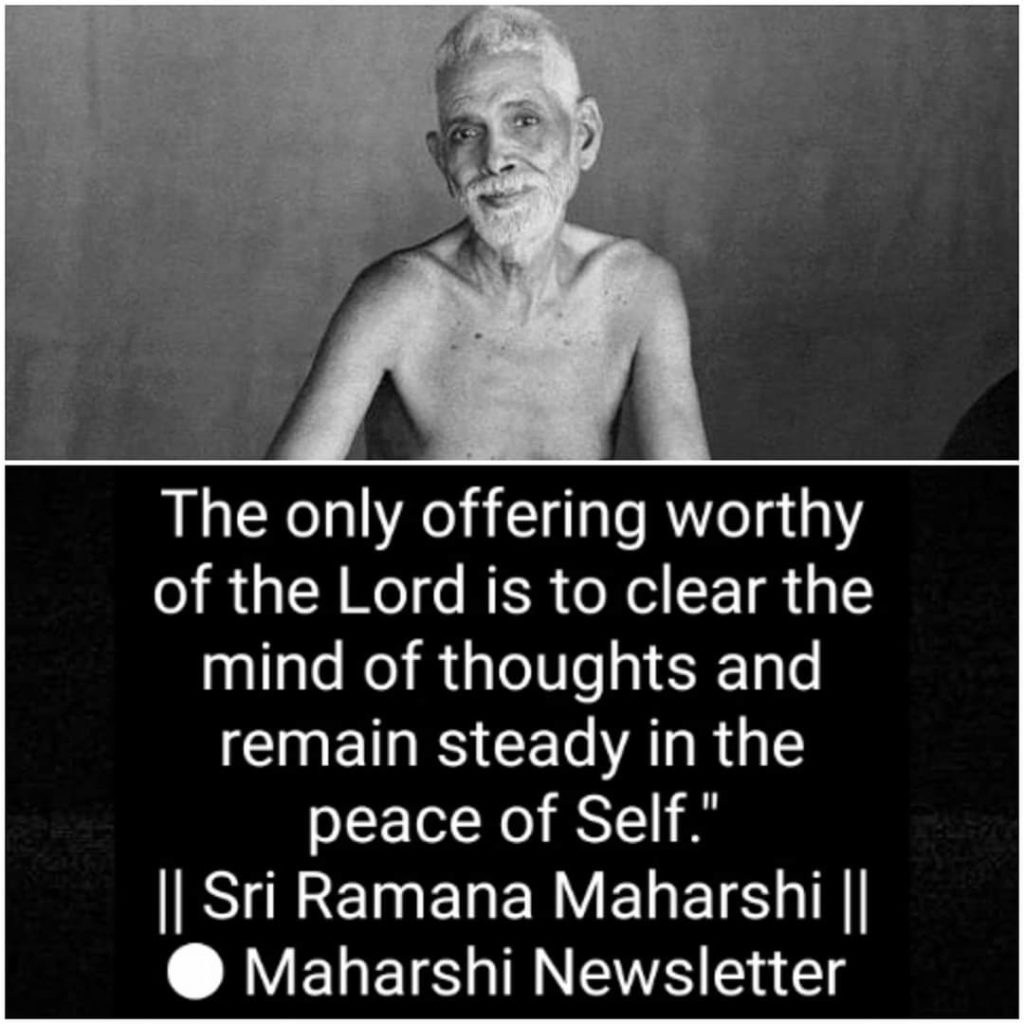
Somebody brought a bell to be rung at the arati ceremony and it was put into Bhagavan’s hands. He tried its sound in various ways and laughed: “God wants us to make a fire of our past evil deeds and burn our karma in it. But these people burn a copper worth of camphor and hope to please the Almighty. Do they really believe that they can get something for nothing? They do not want to bend to God, they want God to bend to them. In their greed they would swallow God, but they would not let him swallow them. Some boast of their offerings. What have they got to offer ? The idol of Vinayaka (Ganesha) is made of jaggery. They break off a piece of it and offer it to Him. The only offering worthy of the Lord is to clear the mind of thoughts and remain steady in the peace of Self.”

✅ As I Saw Him – No.5. My Life, My Light
by Varanasi Subbalakshmi.
Source: THE MAHARSHI.
Nov / Dec 1991. Vol.1 No.5

Had to get this out -rjs

SOMETIMES PEOPLE DON’T QUITE “GET” ME. I don’t want to write a post about me but Papa says I gotta do it so here goes. I didn’t ever want to say this coz I so strongly dislike religious terminology but I believe I’m “anointed”. Good grief I said it!! Now all’s I gotta do is vindicate my statement, then I’m done, right Papa? Okay here goes.
I had more on my shoulders than most adults do in a lifetime, not expected to live time and again and I was like 5, 10, 15 years old. I can’t bear to relive the pain of being left so all alone – with a bible!!! – to heal myself when it was so beneficial to keep me down. I don’t know how I survived but I sure did learn to rely entirely on God.
Not physical rape but emotional dogged me since forever, and yet I can smile victoriously as I learned to use each and every incident as a stepping stone to deeper/ higher/ farther exploitations of Holy Spirit than I ever deemed possible.
I guess somewhere along the way I discovered that my niche was in the very process of dis–covering my spiritual being and abode commencing almost at birth!
Btw, lest I forget, you precious reader are not one iota less anointed than I am. Now I think I’ve said it all.

Sat (Existence) -Chit (Consciousness) -Ananda (Bliss)

Everything is Sat-Chit-Ananda -Self only

▪︎▪︎▪︎▪︎▪︎▪︎▪︎

Whatever is found to exist is Sat (Existence) only.
Whatever is pleasurable is Ananda (Bliss) only.

One should ever abide in the
bedrock bhavana of Sat-Chit-Ananda.

Never for once should oneslip,
even inadvertently,
into the disastrous bhavana that one is the
body and that the world is real.

🕉 Ribhu Gita. Ch.25, v.12

■■■■■■■■■■■■■■■■■■■■■■■■

Satchitananda (Sanskrit: सच्चिदानंद, IASTSaccidānanda) or Sacchidānanda representing “existence, consciousness, and bliss” or “truth, consciousness, bliss”, is an epithet and description for the subjective experience of the ultimate unchanging reality, called Brahman, in certain branches of Hindu philosophy, especially Vedanta.

Etymology

Satchitananda (Sanskrit: सच्चिदानन्द) is a compounded Sanskrit word consisting of “sat”, “chit” and “ananda”, all three considered as inseparable from the nature of ultimate reality called Brahman in Hinduism. The different forms of spelling is driven by euphonic (sandhi) rules of Sanskrit, useful in different contexts.

  • sat (सत्): In Sanskrit sat means “being, existence”, “real, actual”, “true, good, right”, or “that which really is, existence, essence, true being, really existent, good, true”.
  • chit (चित्): means “consciousness”.
  • ānanda (आनन्द): means “happiness, joy, bliss”, “pure happiness, one of three attributes of Atman or Brahman in the Vedanta philosophy”. Loctefeld and other scholars translate ananda as “bliss”.

Satchitananda is therefore translated as “Truth Consciousness Bliss”, “Reality Consciousness Bliss”, or “Existence Consciousness Bliss”.

Discussion

The term is contextually related to “the ultimate reality” in various schools of Hindu traditions. In theistic traditions, sacchidananda is same as God such as Vishnu, Shiva or Goddess in Shakti traditions. In monist traditions, sacchidananda is considered directly inseparable from nirguna (attributeless) Brahman or the “universal wholeness of existence”, wherein the Brahman is identical with Atman, the true individual self. Satchitananda or Brahman is held to be the source of all reality, source of all conscious thought, and source of all perfection-bliss. It is the ultimate, the complete, the destination of spiritual pursuit in Hinduism.

Textual references

The Brihadaranyaka Upanishad (c. 800–600 BCE) is among the earliest Hindu texts which links and then discusses Atman (soul), Brahman (ultimate reality), awareness, joy and bliss such as in sections 2.4, 3.9 and 4.3. The Chandogya Upanishad (~800-600 BCE), in section 3.14 to 3.18, discusses Atman and Brahman, these being identical to “that which shines and glows both inside and outside”, “dear”, “pure knowing, awareness”, “one’s innermost being”, “highest light”, “luminous”. Other 1st-millennium BCE texts, such as the Taittiriya Upanishad in section 2.1, as well as minor Upanishads, discuss Atman and Brahman in saccidananda-related terminology.

An early mention of the compound word sacchidananda is in verse 3.11 of Tejobindu Upanishad, composed before the 4th-century CE. The context of sacchidananda is explained in the Upanishad as follows:

The realization of Atman.

(…) I am of the nature of consciousness.
I am made of consciousness and bliss.
I am nondual, pure in form, absolute knowledge, absolute love.
I am changeless, devoid of desire or anger, I am detached.
I am One Essence, unlimitedness, utter consciousness.
I am boundless Bliss, existence and transcendent Bliss.
I am the Atman, that revels in itself.
I am the Sacchidananda that is eternal, enlightened and pure.— Tejobindu Upanishad, 3.1-3.12 (Abridged)

Vedanta philosophy

Main article: Vedanta

The Vedantic philosophy understands saccidānanda as a synonym of the three fundamental attributes of Brahman. In Advaita Vedanta, states Werner, it is the sublimely blissful experience of the boundless, pure consciousness and represents the unity of spiritual essence of ultimate reality.

Saccidānanda is an epithet for Brahman, considered indescribable, unitary, ultimate, unchanging reality in Hinduism.

Vaishnava philosophy

Main article: Vaishnavism

Tulsidas considers Rama as Satcitananda.

Just simply be free! -RAdams

It takes a simple mind to awaken. When your mind is too complicated, when you’re filled with theoretical knowledge, abstract knowledge, psychological knowledge any kind of knowledge, this is what keeps you bound to maya [illusion]. Yet you keep holding on to this knowledge because you feel that if you let go of it you’ll be a fool or a vegetable. Nothing is further from the truth. The truth is that the more you give up, the greater the happiness and peace that comes to you. For your very nature is happiness and peace.
Do not be concerned about what anyone else is doing. Leave everyone alone, leave people alone, leave things alone. Always realize you are in your right place. Do not strive to be in somebody else’s place. You have nothing to fight, nothing to fear. Everything is on your side. There is no thing that wants to hurt you. Keep your life simple. Do not make this teaching complicated. Do not calculate the reason behind this teaching. Leave everything alone. Awaken and be free. All is well.
~ Robert Adams

The wrong ‘I’ is the obstruction.
It has to be removed in order that
the true ‘I’ may not be hidden. The
feeling that I have not realised is
the obstruction to realisation.
In fact, it is already realised
and there is nothing more
to be realised. Otherwise,
the realisation will be new.

Shri Ramana Maharshi